Fox Head 2 Clay Cutter - Animal STL Digi: Evaluating Design Versatility and Print Specifications
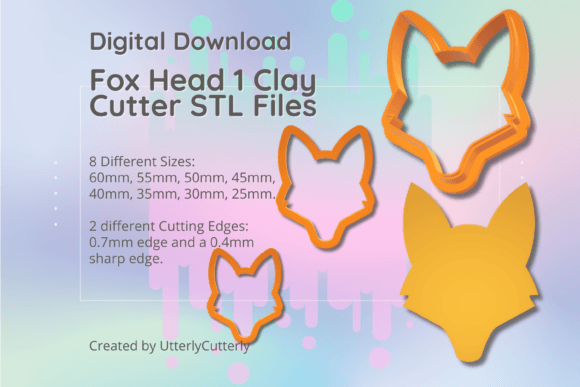
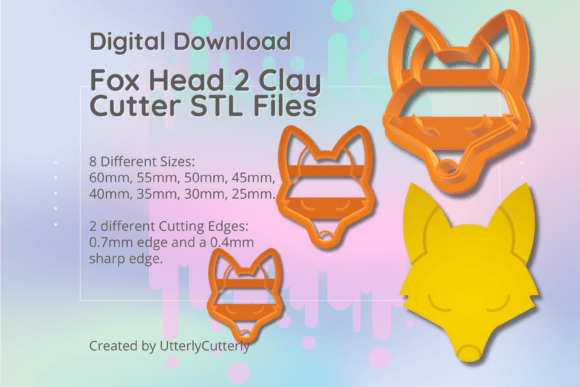
Selecting the right digital assets for polymer clay or cookie crafting requires more than just finding an appealing silhouette. When evaluating the Fox Head 2 Clay Cutter - Animal STL Digi, makers must consider technical specifications, printability, and how the design integrates into a broader workflow. This digital download provides a specific set of tools designed for users who own 3D printers and require precision over generic shapes. Unlike physical cutters that arrive with fixed dimensions, this STL bundle offers eight distinct sizes ranging from 25mm to 60mm, allowing for curated scaling that matches specific project requirements.
The distinction of this particular animal cutter lies in its dual-edge engineering. Makers often face a tradeoff between durability and cutting precision when printing their own tools. This file pack addresses that friction by including two distinct cutter types: a standard 0.7mm wall for structural integrity and a Sharp Edge (SE) variant with a 0.4mm cutting edge supported by a 1mm wall. Understanding when to utilize each version is essential for achieving professional results without wasting filament or post-processing time.
Technical Specifications and Printability Assessment
Before adding any STL file to a print queue, it is necessary to verify that the geometry aligns with your printer’s capabilities and your material’s behavior. The Fox Head 2 Clay Cutter - Animal STL Digi is engineered with specific base and height parameters that influence both print success and functional performance.
- Base Thickness: Both cutter variations feature a 3mm thick base. This provides sufficient surface area for bed adhesion during printing and offers a comfortable grip for the user during cutting. Thinner bases can sometimes warp on heated beds or dig uncomfortably into the hand during extended use.
- Cutter Height: The total height is standardized at 12mm. This dimension is critical for clearance. It accommodates most standard polymer clay thicknesses while remaining low enough to prevent excessive wobble if the cutter is not perfectly perpendicular to the work surface.
- Embossing Considerations: For designs featuring internal detail lines, the embossing elements are raised 10.5mm from the base. This leaves a 1.5mm gap relative to the cutting rim. Practically, this means the clay must be conditioned to a thickness greater than 1.5mm to capture the impression. If working with very thin sheets (under 1mm), the embossing may bottom out or fail to register clearly.
When comparing this digital asset to other animal-themed STL files on the market, the inclusion of these precise measurements reduces trial and error. Many free or lower-cost alternatives lack documented tolerances, leading to failed prints where walls are too thin to extrude reliably or embossing details are lost in layer lines. The tested nature of these files suggests a higher baseline for reliability, though users should still calibrate their flow rate and retraction settings specifically for small-nozzle detailing.
Standard Wall vs. Sharp Edge: Choosing the Right Variant
The availability of two cutting edge profiles within the same digital pack allows for application-specific tool selection. Neither option is universally superior; rather, they serve different stages of the making process or different material states.
The 0.7mm Standard Wall
This version features a 0.7mm wall thickness. In the context of FDM printing, this is generally equivalent to two perimeters on a 0.4mm nozzle or three perimeters on a 0.3mm nozzle. This thickness prioritizes longevity and ease of printing. It is less prone to layer separation and can withstand firmer pressure when cutting through denser materials like chilled cookie dough or heavily filled polymer clay blends. For makers new to printing functional tools, or those using printers with slight calibration issues, the standard wall is the safer starting point. The tradeoff is a slightly wider cut line, which may require additional smoothing or cleanup on delicate jewelry pieces.
The Sharp Edge (SE) Variant
Abbreviated as SE in the file naming convention, this variant utilizes a 1mm support wall tapering to a 0.4mm cutting edge. This geometry mimics commercial metal cutters more closely than standard printed tools. The primary advantage is a cleaner slice with minimal clay displacement, reducing the need for post-cut sanding. However, the 0.4mm tip presents printing challenges. It requires optimal cooling and precise extrusion multiplier tuning to avoid blobbing or fragility. This variant is best reserved for fine jewelry work, soft clay, or situations where edge definition is paramount. Users should evaluate their printer's ability to handle thin features before committing to large batches of SE cutters.
Sizing Strategy and Workflow Integration
A significant advantage of digital downloads over physical inventory is the ability to scale. The Fox Head 2 Clay Cutter - Animal STL Digi includes eight pre-sized files: 60mm, 55mm, 50mm, 45mm, 40mm, 35mm, 30mm, and 25mm. These measurements refer to the longest ends of the design, ensuring consistent sizing logic across the set.
This graduated sizing facilitates several practical workflows that single-size physical cutters cannot support:
- Nesting Designs: Creating layered pendants or stacked cookies often requires precise size differentials. Having 5mm increments allows makers to create visual depth without guessing proportions.
- Material Conservation: When working with expensive metallic clays or limited-edition doughs, selecting the exact minimum viable size prevents waste. A 25mm cutter uses significantly less volume than a 35mm one, a factor that compounds over production runs.
- Collection Cohesion: For sellers curating themed collections, consistent sizing across different animal motifs creates a professional product line. Because new STL files are added to the store weekly, makers can expand their library while maintaining compatible dimensional standards.
When evaluating this bundle against resizing files manually in slicer software, pre-sized files offer geometric safety. Arbitrary scaling in a slicer can distort wall thicknesses, making a 0.7mm wall unprintably thin or unnecessarily thick. Pre-modeled sizes preserve the engineer’s intended tolerances regardless of the selected dimension.
Comparative Fit: When This Digital Asset Is the Right Choice
Digital fabrication resources are not a universal solution. Determining whether the Fox Head 2 Clay Cutter - Animal STL Digi fits your current needs involves assessing your equipment, timeline, and output goals.
Ideal Use Cases:
- Custom Jewelry Production: The smaller sizes (25mm–40mm) and SE options are specifically suited for earrings, charms, and pendants where detail matters more than speed.
- Iterative Prototyping: If you are developing a new product line and need to test multiple sizes before committing to steel die manufacturing, this digital pack offers a low-risk testing ground.
- Printer Owners Seeking Utility: For those who already possess a 3D printer, the marginal cost of producing these cutters is merely filament and electricity, offering a lower long-term cost-per-tool than purchasing individual metal cutters.
- Cohesive Brand Building: Makers looking to build a recognizable style benefit from accessing a regularly updated library of compatible designs rather than sourcing mismatched tools from disparate vendors.
Situations Requiring Alternatives:
- No 3D Printing Access: As a digital-only product, this is non-functional without hardware. Makers without printers should seek physical brass or stainless steel equivalents.
- High-Volume Commercial Baking: While suitable for cookies, PLA and PETG have temperature limitations. For high-throughput bakery environments involving hot washing or industrial dishwashers, food-grade stainless steel remains the industry standard for hygiene and durability.
- Immediate Need: Digital downloads require print time, post-processing, and potential calibration adjustments. If a project deadline is within hours rather than days, off-the-shelf physical tools eliminate production lead time.
- Sub-1mm Clay Work: Due to the 10.5mm embossing height, this cutter set is incompatible with ultra-thin veneer techniques. Specialized texture sheets or shallower relief cutters would be more appropriate for paper-thin applications.
Evaluating Value Beyond the Initial Download
When researching digital maker resources, consider the ecosystem surrounding the specific file. The Fox Head 2 Clay Cutter - Animal STL Digi represents a modular approach to tool acquisition. Rather than viewing it as an isolated purchase, evaluate it as part of a scalable system. The weekly release schedule mentioned by the provider indicates active development, which typically correlates with better file quality and responsiveness to community feedback compared to abandoned repositories.
Furthermore, the testing protocol referenced in the product description adds a layer of assurance. In the open-source STL landscape, untested files frequently contain non-manifold geometry or impossible overhangs. Verified files reduce the hidden costs of failed prints and troubleshooting time. For adult makers balancing creative pursuits with limited leisure time, reliability often outweighs the nominal savings of unverified free alternatives.
Ultimately, the decision to acquire this digital bundle should hinge on your specific production parameters. If you require versatile sizing, dual-edge functionality, and tested geometry for jewelry or detailed clay work, this asset aligns well with professional and serious hobbyist standards. If your needs fall outside the 25mm–60mm range or require industrial-grade thermal resistance, exploring specialized manufacturing services or alternative materials may yield better long-term outcomes. By matching the tool’s technical reality to your project’s demands, you ensure that your investment in digital fabrication translates directly into tangible creative output.