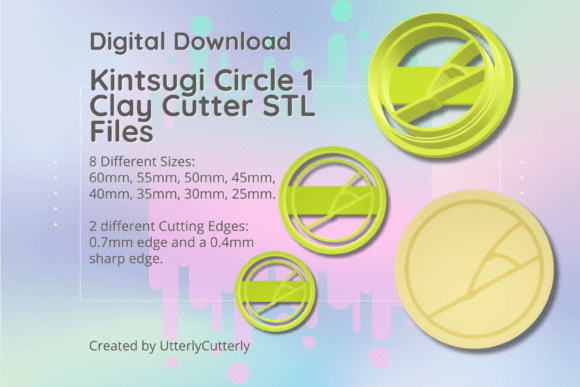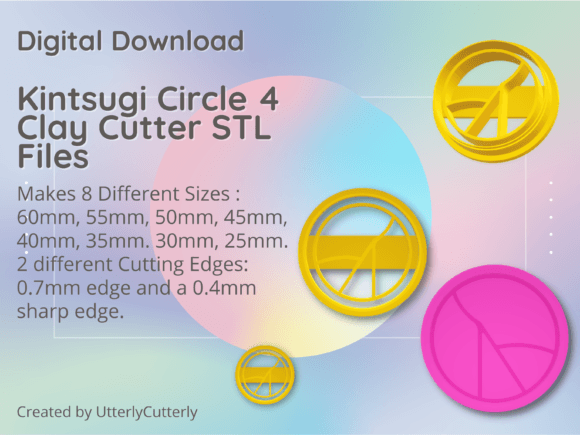
Kintsugi Circle 4 Clay Cutter - STL Digi: Elevating Polymer Clay and Cookie Design
The philosophy of Kintsugi celebrates imperfection, treating breakage and repair as part of the history of an object rather than something to disguise. Translating this ancient Japanese art form into modern digital fabrication, the Kintsugi Circle 4 Clay Cutter - STL Digi offers creators a way to embed this meaningful aesthetic directly into their workflow. This digital download provides a comprehensive bundle of STL files designed specifically for 3D printing, allowing you to produce physical cutters that mimic the organic, repaired lines characteristic of Kintsugi pottery. Rather than purchasing a single fixed tool, this digital asset empowers you to manufacture a versatile suite of eight distinct sizes, ensuring you have the exact dimensions needed for jewelry, ceramics, or culinary projects.
Practical Applications Across Creative Disciplines
The true value of this STL bundle lies in its adaptability across different mediums. While primarily marketed toward polymer clay artists, the geometric precision and varied sizing make these cutters relevant for several distinct user groups. Understanding where and when to deploy specific sizes or edge types can significantly streamline your production process.
Polymer Clay Jewelry and Earring Design
For jewelry makers, consistency in sizing is often the difference between a hobbyist piece and a professional product. The Kintsugi Circle 4 pack includes sizes ranging from 25mm to 60mm, measured from the longest ends. This gradation is particularly useful for creating nested earring sets or graduated pendant collections. When working with polymer clay, the 0.7mm wall option provides a sturdy cutting edge that maintains the structural integrity of the cutter during repeated use on firmer clays like Sculpey III or Fimo Professional. Conversely, if you are slicing through softer, conditioned clay or require a cleaner finish for translucent materials, the Sharp Edge (SE) variant with its 0.4mm cutting profile reduces drag and minimizes post-cut sanding.
Ceramics and Pottery Embossing
Potters and ceramicists will find specific utility in the embossing capabilities of these files. With embossing lines set at 10.5mm tall, these cutters are engineered to work effectively with clay bodies thicker than 1.5mm. This depth allows for significant texture without compromising the structural stability of greenware. A potter might use the 60mm or 55mm cutters to create decorative medallions for vessel surfaces, while the smaller 30mm or 25mm options serve as stamps for rim details. Because these are digital files, you can print replacements instantly if a cutter breaks in the studio, eliminating downtime associated with shipping physical tools.
Culinary Arts and Baking
Bakers and cookie decorators benefit from the food-safe potential of 3D printed cutters, provided appropriate materials and post-processing are used. The Kintsugi aesthetic translates beautifully to fondant work, shortbread cookies, and cake toppers. In a commercial bakery setting, having access to eight precise sizes allows for efficient nesting on baking sheets, reducing waste and maximizing oven space. The 12mm height of the base ensures the cutter clears thicker doughs or rolled fondant without the handle pressing into the surface, preserving the intricate Kintsugi line work.
Understanding Technical Specifications for Optimal Results
Before downloading and printing the Kintsugi Circle 4 Clay Cutter - STL Digi, it is essential to understand the technical distinctions between the two included cutter types. Choosing the wrong profile for your material can lead to frustration or subpar results.
- Standard Wall (0.7mm): Features a 0.7mm wall thickness with a 3mm thick base and 12mm total height. This is the workhorse option, ideal for general-purpose polymer clay, metal clay, and thicker ceramic slabs where durability is prioritized over razor-sharp precision.
- Sharp Edge (SE): Abbreviated as SE in the file names, this variant features a 1mm support wall backing a 0.4mm cutting edge. Despite the finer edge, it maintains the same 3mm base and 12mm height for ergonomic handling. Use this for detailed jewelry components, soft clays, or applications requiring minimal cleanup.
All cutters in this bundle share a consistent 12mm height and 3mm base thickness. This standardization means they stack neatly for storage and feel uniform in hand, reducing fatigue during long production runs. The embossing lines, standing at 10.5mm, leave a 1.5mm clearance at the base, which acts as a natural depth stop to prevent over-pressing.
Considerations Before Downloading and Printing
As a digital product, the success of the Kintsugi Circle 4 Clay Cutter - STL Digi depends heavily on your 3D printing setup and material choices. Unlike physical tools that arrive ready-to-use, STL files require preparation and calibration.
Printer Calibration and Material Selection
These files are designed to be easily printed, but "easily" assumes a well-calibrated machine. For the Sharp Edge variants, ensure your printer’s flow rate and retraction settings are dialed in to prevent blobbing on the fine 0.4mm tip. PLA is generally sufficient for polymer clay and fondant, but if you plan to use these with abrasive materials like groggy stoneware clay or metal clay, consider printing in PETG or ABS for increased wear resistance. Always verify layer adhesion; a delaminated cutter can harbor bacteria in food applications or fail catastrophically under pressure.
Sizing Verification
Remember that cutter size is measured from the longest ends due to the organic Kintsugi geometry. A 40mm cutter may not yield a perfect 40mm circle after clay shrinkage or baking. It is advisable to print a test cutter and measure the actual output with your specific clay body before committing to a full production run. This is especially critical for jewelry makers who need to account for polymer clay shrinkage rates, which typically range from 2% to 10% depending on the brand.
Digital Asset Management
Since this is not a physical item, you gain immediate access upon payment. Organize your STL library systematically, perhaps by size or edge type, to avoid confusion during printing sessions. The files are tested for printability, but keeping notes on your preferred slicer settings for each variant will save time in future projects. As new STL files are added to the store weekly, maintaining a curated folder system helps integrate new designs with existing ones for cohesive collection building.
Building Versatile Collections Through Modular Design
One of the most compelling aspects of digital cutter libraries is the ability to curate custom combinations. The Kintsugi Circle 4 pack is designed to complement other STL files in the ecosystem. A jewelry designer might pair the 35mm and 30mm Kintsugi circles with complementary floral or geometric cutters to create a signature collection that tells a visual story. Educators teaching art therapy or mindfulness can use the Kintsugi theme as a metaphor for resilience, having students create pieces that physically embody the concept of healing through the act of making.
For small business owners, this modularity translates to inventory flexibility. Instead of stocking dozens of physical cutters that may never sell, you maintain a digital library and print on demand. This reduces overhead and allows for rapid prototyping of new product lines. If a particular size becomes popular during a holiday season, you can print additional units overnight without waiting for supplier restocks.
Ultimately, the Kintsugi Circle 4 Clay Cutter - STL Digi represents more than just a set of cutting tools; it is a bridge between traditional craftsmanship and modern digital fabrication. Whether you are crafting meaningful jewelry, decorating artisanal baked goods, or exploring therapeutic clay work, these files provide the precision and versatility needed to bring your vision to life. By understanding the technical nuances and applying them thoughtfully to your specific context, you transform a simple digital download into an indispensable part of your creative practice.