Arch Window 3 Clay Cutter STL: Digital Design Specifications and Practical Application
The Arch Window 3 Clay Cutter - STL Digital represents a specific category of functional manufacturing assets designed for polymer clay artists, ceramicists, and culinary creators. Unlike generic shape files, this digital download provides a comprehensive system for producing architectural-style cutters with precise dimensional control. For professionals and serious hobbyists utilizing FDM or resin 3D printing, the value of such a file lies not merely in the aesthetic shape but in the engineered printability and the inclusion of multiple cutting edge profiles. This bundle addresses common pain points in DIY cutter production, specifically wall thickness consistency, edge sharpness options, and size gradation.
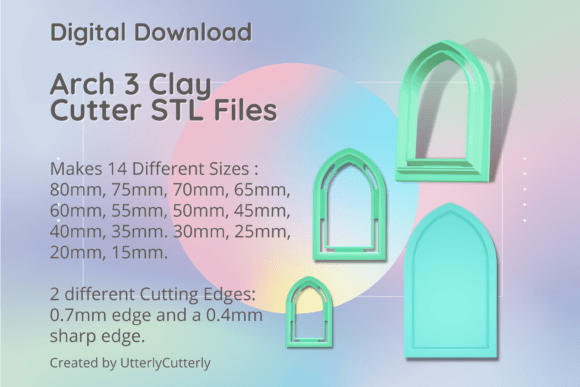
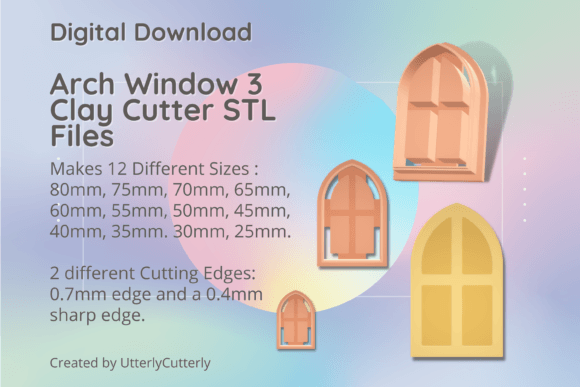
When evaluating digital fabrication files for creative tools, one must look beyond the visual preview. The Arch Window 3 pack distinguishes itself by offering twelve distinct sizes ranging from 25mm to 80mm, measured from the longest ends. This graduated sizing allows for curated nesting sets or progressive design elements within a single project. Furthermore, the inclusion of two distinct cutter types—a standard 0.7mm wall and a specialized Sharp Edge (SE) variant—demonstrates an understanding of material behavior. Whether you are working with soft polymer clay, air-dry compounds, or cookie dough, having selectable edge geometries ensures the tool performs effectively across different media viscosities.
Technical Specifications and Print Optimization
Successful 3D printing of clay cutters requires balancing durability with cutting efficiency. The Arch Window 3 Clay Cutter - STL Digital has been modeled with specific parameters that facilitate reliable printing on standard consumer hardware. Understanding these specifications is essential for achieving optimal results without excessive post-processing or failed prints.
- Standard Wall Configuration: Features a 0.7mm wall thickness with a 3mm thick base and a total height of 12mm. This profile offers structural rigidity suitable for stiffer clays while maintaining a manageable cutting resistance.
- Sharp Edge (SE) Variant: Abbreviated as SE in the file set, this version utilizes a 1mm support wall transitioning to a 0.4mm cutting edge. It shares the same 3mm base and 12mm height as the standard version but is engineered for cleaner slices in softer materials.
- Embossing Compatibility: Any embossing details integrated into the design are set at 10.5mm tall. This specific depth requires the user to condition clay to a minimum thickness of 1.5mm to prevent bottoming out or tearing during impression.
- Size Gradation: The bundle includes incremental steps at 80mm, 75mm, 70mm, 65mm, 60mm, 55mm, 50mm, 45mm, 40mm, 35mm, 30mm, and 25mm.
These dimensions are not arbitrary. A 12mm height provides sufficient clearance for knuckles when pressing into thicker slabs, while the 3mm base ensures the cutter remains rigid during the extrusion force of cutting. The 0.4mm sharp edge option is particularly significant for users who have previously struggled with the dragging or deformation often caused by thicker-walled printed cutters. By providing both options in a single digital package, the designer eliminates the need to modify meshes manually, saving time and reducing the risk of non-manifold geometry errors.
Material Versatility and Workflow Integration
The practical utility of the Arch Window 3 Clay Cutter - STL Digital extends across multiple disciplines. While primarily marketed toward jewelry makers and ceramic artists, the geometric precision makes it equally valuable for culinary applications. However, performance varies significantly based on the material being processed and the chosen cutter variant.
Polymer Clay and Jewelry Making
For earring and pendant creation, the smaller sizes (25mm–45mm) are typically most relevant. The Sharp Edge (SE) files are recommended here, as polymer clay can be unforgiving regarding edge definition. The 0.4mm cutting edge minimizes the "lip" of excess clay that often forms with standard cutters, reducing cleanup time before baking. When using the embossing features, ensuring your clay slab is rolled to at least 1.5mm is critical; anything thinner risks the embosser contacting the work surface, which can damage both the print and the piece.
Ceramics and Air-Dry Clay
Stoneware and earthenware clays possess higher shear strength than polymer. In these scenarios, the standard 0.7mm wall configuration often outperforms the SE variant. The slightly thicker wall resists deformation when pressing into groggy or leather-hard clay. The larger sizes in this bundle (60mm–80mm) serve well for vessel components, decorative tiles, or architectural relief work. The 12mm height is adequate for most hand-building slab thicknesses, though users working with coils or very thick slabs should test the clearance first.
Culinary Applications
While STL files are digital, the resulting physical objects can be used for cookies and fondant provided food-safe printing protocols are followed. The arch window shape creates elegant biscuits for weddings or heritage-themed events. For dough, the standard wall is generally preferred as it prevents the cutter from flexing during the twist-and-lift motion required for clean release. Users must ensure they use food-safe filament and seal the printed layers appropriately, as FDM prints naturally harbor bacteria in layer lines.
Evaluating Digital Asset Value and Usability
In a marketplace saturated with free and paid STL files, assessing the long-term value of the Arch Window 3 Clay Cutter - STL Digital requires looking at workflow efficiency and design coherence. This bundle supports a professional approach to maker businesses where consistency is key.
Design Consistency: Having twelve mathematically related sizes allows creators to develop cohesive product lines. Rather than sourcing mismatched arch shapes from different designers, this pack ensures that the curvature, proportions, and wall styles remain identical across all scales. This is vital for branding and for creating nested sets that store efficiently.
Print Reliability: Files described as "easily printed" typically feature optimized overhang angles and bridging distances. The 3mm base acts as a built-in brim equivalent, improving bed adhesion for the narrow vertical walls of the arch shape. This reduces the need for external supports, which can leave blemishes on the cutting edge. For users running print farms or small batch production, this reliability translates directly to reduced waste and machine time.
Expansion Potential: The mention of new STL files arriving weekly suggests an active development pipeline. For entrepreneurs building a shop around architectural motifs, this indicates future compatibility. Investing in a core system like Arch Window 3 now may streamline future expansions, as the designer likely maintains consistent tolerances and naming conventions across releases.
Practical Considerations and Limitations
Despite its strengths, prospective users should approach this digital asset with realistic expectations. As a digital download, there is no physical quality assurance; the final tool's performance depends entirely on your printer’s calibration and material choice.
- Printer Calibration: The 0.4mm sharp edge is near the limit of standard 0.4mm nozzle resolution. Users must have their flow rate and retraction tuned precisely to avoid clogging or under-extrusion on these fine features. Resin printers may handle this detail better but require careful washing to remove uncured resin from thin gaps.
- Sizing Verification: Always measure your printed output against the specified dimensions. Printer shrinkage rates vary by filament type (PLA vs. PETG vs. ABS). You may need to apply a scaling factor in your slicer to achieve the exact 80mm or 25mm targets.
- Embossing Depth Awareness: The 10.5mm embossing height is substantial. If you frequently work with thin sheets (under 1.5mm), this feature may be unusable without modification. Conversely, for deep-relief work, this depth provides excellent definition that shallower cutters cannot achieve.
- Digital Nature: Remember that this is not a physical item. Access is granted immediately after purchase, but troubleshooting print issues falls on the user. Familiarity with your slicer software and basic mesh repair tools is assumed.
The Arch Window 3 Clay Cutter - STL Digital serves as a robust foundational asset for makers requiring architectural precision. Its dual-edge strategy and comprehensive sizing address real-world fabrication challenges rather than offering mere novelty. For those willing to dial in their printer settings, it offers a scalable, versatile solution for producing professional-grade cutting tools on demand. Whether expanding a jewelry business or refining a personal craft practice, the technical thoughtfulness embedded in these files justifies their place in a serious digital library.