Arch Shape 3 Clay Cutter - Framed Border: Technical Specifications and Digital Fabrication Guide
The intersection of digital fabrication and tactile craftsmanship has revolutionized how artisans approach polymer clay, ceramic modeling, and culinary arts. Central to this evolution is the availability of precision-engineered STL files that allow creators to manufacture their own tools on demand. The Arch Shape 3 Clay Cutter - Framed Border represents a sophisticated iteration in this space, offering a digital download bundle specifically optimized for FDM (Fused Deposition Modeling) printing. Unlike generic shapes, this collection focuses on the architectural elegance of the arch form combined with a functional framed border imprint, providing makers with a versatile system for creating consistent, professional-grade impressions.
Understanding the Dual-Edge Engineering System
A defining characteristic of high-quality clay cutter STL files is the recognition that different materials require different cutting geometries. This digital pack addresses that necessity by including two distinct cutter types within the same size range. Understanding the mechanical differences between these edges is crucial for achieving optimal results across various mediums, from soft ear clays to denser cookie doughs.
The Standard 0.7mm Wall Configuration
The first variation features a robust 0.7mm wall thickness paired with a 3mm thick base and a total height of 12mm. This specification serves as the workhorse for general-purpose crafting. The 0.7mm edge provides sufficient rigidity to prevent warping during the pressing motion, which is particularly important when working with firmer polymer clays or when applying significant downward pressure to achieve a deep frame impression. The 3mm base acts as a comfortable handle surface, distributing force evenly across the user's hand and preventing the thin cutting edge from digging into fingers during repetitive use. This balance of durability and comfort makes the standard configuration ideal for production environments where tool longevity and user ergonomics are priorities.
The Sharp Edge (SE) Variant
For applications requiring pristine definition and minimal material displacement, the Sharp Edge variant—abbreviated as SE in the file naming convention—offers a refined alternative. This design utilizes a 1mm support wall that tapers down to a precise 0.4mm cutting edge. While maintaining the same 3mm base and 12mm height as the standard version, the reduced contact area at the cutting point significantly lowers resistance. This geometry excels in delicate tasks, such as slicing through translucent canes or creating clean outlines in soft pastillage without dragging or distorting the surrounding material. The SE files are essential for detail-oriented jewelry makers who prioritize crisp boundaries over structural bulk.
Dimensional Graduation and Modular Scalability
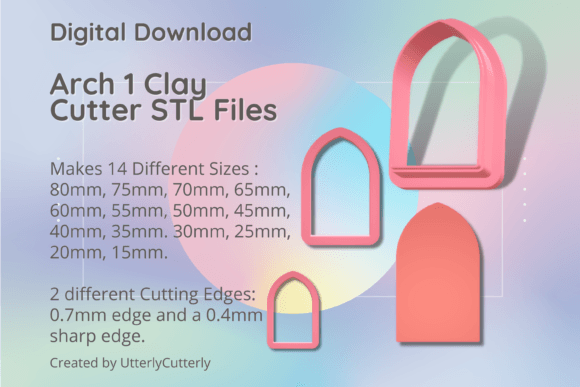
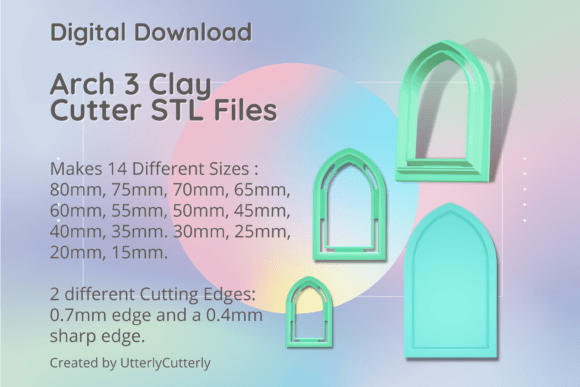
Versatility in design often hinges on scale. A single arch shape may serve as a statement earring at one size and a subtle texture element at another. This STL bundle acknowledges the need for granular sizing by providing fourteen incremental variations. Measured from the longest ends, the sizes progress in logical 5mm steps: 80mm, 75mm, 70mm, 65mm, 60mm, 55mm, 50mm, 45mm, 40mm, 35mm, 30mm, 25mm, 20mm, and 15mm.
This systematic graduation allows creators to curate custom sets tailored to specific projects. For instance, a jeweler designing a nested pendant set might utilize the 40mm, 30mm, and 20mm cutters to create perfectly proportioned layers. Conversely, a baker decorating tiered cakes could employ the larger 80mm through 60mm range to establish visual hierarchy. Because these are digital assets, users are not locked into pre-determined physical sets; they can print only the sizes relevant to their current workflow, reducing plastic waste and storage requirements. Furthermore, this standardized sizing logic ensures compatibility with other STL files in the ecosystem, enabling mixed-shape compositions that maintain mathematical harmony.
The Mechanics of the Framed Border Imprint
The "Framed Border" aspect of the Arch Shape 3 Clay Cutter distinguishes it from simple outline cutters. This feature integrates a secondary relief structure positioned exactly 2mm inward from the primary cutting edge. This internal border creates a recessed channel or raised frame effect within the clay body, adding dimensional complexity without requiring additional hand-carving or separate stamping tools.
Critically, the embossing lines associated with this frame are designed with a height of 10.5mm relative to the cutter base. Given the total cutter height of 12mm, this leaves a 1.5mm clearance at the top. This engineering constraint dictates a minimum material thickness: users must ensure their rolled clay or dough exceeds 1.5mm to fully engage the embossing feature. If the material is too thin, the cutting edge will penetrate before the frame makes full contact, resulting in an incomplete impression. Adhering to this thickness guideline ensures that the framed border registers clearly, providing a professional finish that enhances both the aesthetic value and the structural integrity of the final piece.
Optimizing Print Parameters for Functional Tools
While the STL files are designed for ease of printing, achieving food-safe and craft-ready results requires appropriate slicer settings. The digital nature of this product places the responsibility of manufacturing quality on the end-user, making technical literacy a key component of success.
- Material Selection: Food-grade PLA is recommended for cookie applications due to its biodegradability and safety profile. For polymer clay, PETG or ABS offers superior heat resistance and durability, especially if the cutters will be used with warm clay or cleaned with hot water.
- Layer Height: A layer height of 0.12mm to 0.16mm is optimal for balancing print time with surface smoothness. Finer layers reduce the stair-stepping effect on the curved arch surfaces, resulting in cleaner cuts and easier release.
- Infill and Walls: Minimum 3-4 perimeter walls are advised to ensure the 0.7mm and 0.4mm cutting edges are solid rather than hollow. Infill density can remain low (15-20%) since the structural strength comes primarily from the outer shells and the reinforced 3mm base.
- Brim Usage: Given the narrow footprint of the cutting edge, utilizing a brim is highly recommended to prevent bed adhesion failures. The brim should be removed post-print with care to avoid damaging the precise cutting geometry.
Post-Processing and Safety Considerations
FDM printed tools inherently possess layer lines that can harbor bacteria or cause drag on sticky materials. Proper post-processing transforms a raw print into a functional instrument. For the Sharp Edge variants, light sanding with fine-grit paper (600-1000 grit) along the cutting face can improve performance, but users must exercise extreme caution to preserve the 0.4mm tolerance. Over-sanding can blunt the edge or alter the critical 2mm spacing of the framed border.
Hygiene protocols differ based on application. Polymer clay artists should dedicate specific cutters to clay use only, as clay residues can permanently contaminate the porous plastic. Cookie and fondant users must seal their prints with a food-safe epoxy resin or similar coating to create a non-porous barrier. This step is non-negotiable for any item intended for food contact, as untreated 3D prints cannot be effectively sanitized. Additionally, because this is a digital download and not a physical item, users assume all liability regarding material safety and printer calibration. The STL files provide the geometric data, but the functional outcome depends entirely on local manufacturing variables.
Integrating Digital Assets into Creative Workflows
The true value of the Arch Shape 3 Clay Cutter - Framed Border lies in its integration into broader creative systems. With new STL files added to the store weekly, this arch collection serves as a foundational module rather than a standalone novelty. Designers can combine these framed arches with complementary textures, floral elements, or geometric grids available in the expanding library to develop signature styles that are difficult to replicate with mass-produced tools.
For educators and workshop leaders, digital files offer logistical advantages. Instead of shipping fragile physical inventory, instructors can distribute STL links to participants, ensuring everyone works with identical tools regardless of location. This democratizes access to specialized equipment and encourages students to learn additive manufacturing alongside traditional handcraft skills. Small business owners benefit similarly by eliminating tool procurement lead times; if a cutter breaks mid-production run, a replacement can be printed in under an hour, minimizing downtime.
Ultimately, mastering these digital tools requires a shift in mindset from passive consumption to active fabrication. By understanding the interplay between wall thickness, embossing depth, and material properties, creators unlock the full potential of the Arch Shape 3 system. Whether producing intricate jewelry components or artisanal baked goods, the precision embedded in these STL files translates directly to elevated craftsmanship, provided the user respects the technical parameters that define their performance.