Fox Head 1 Clay Cutter - Animal STL Digi: Integrating Digital Assets into Your Production Workflow
The Fox Head 1 Clay Cutter - Animal STL Digi represents more than just a single shape; it is a modular component within a broader digital fabrication ecosystem. For creators, small business owners, and hobbyists utilizing 3D printing technology, this digital download serves as a foundational asset for producing polymer clay jewelry, ceramic components, or cookie decorations. Understanding how to integrate this specific STL file bundle into your existing workflow is essential for maximizing efficiency and ensuring consistent output quality. Unlike purchasing physical tools that arrive with fixed specifications, acquiring the Fox Head 1 Clay Cutter - Animal STL Digi allows you to control the manufacturing variables, adapting the tool to fit specific project requirements rather than forcing your project to adapt to a store-bought limitation.
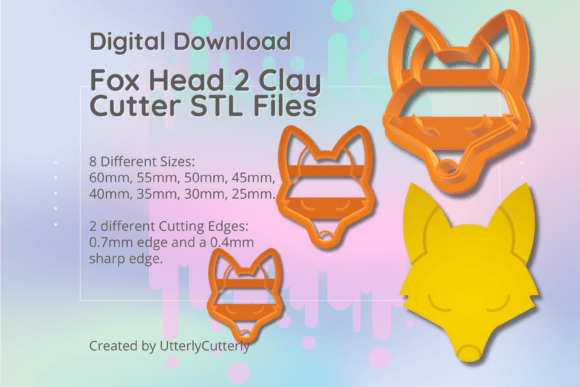
This digital asset fits into the pre-production and prototyping phases of creative work. Before committing to a large batch of handmade goods, professionals use these files to test material behavior, gauge market interest in specific animal motifs, and refine their finishing processes. The ability to print ten distinct sizes ranging from 15mm to 60mm enables rapid iteration. You can produce sample sets in minutes, evaluate the ergonomics of the handle and the sharpness of the blade against your specific clay body, and adjust your printer settings accordingly before scaling up production. This reduces waste and ensures that when you begin final fabrication, your tools are optimized for the task at hand.
Technical Specifications and Print Preparation
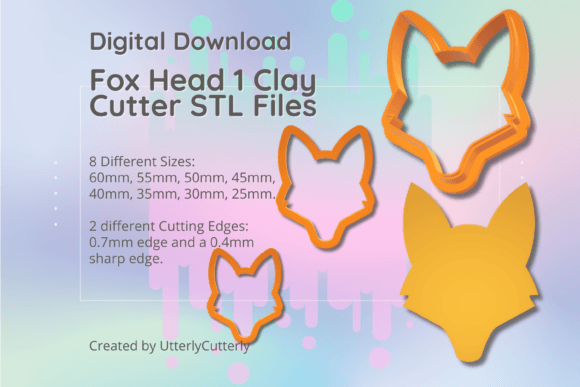
Successful integration of the Fox Head 1 Clay Cutter - Animal STL Digi begins with understanding the technical parameters provided in the file bundle. This pack includes two distinct cutting edge profiles designed for different stages of the creative process and varying material densities. Proper selection during the slicing phase prevents print failures and ensures the cutter performs as intended.
- Standard Edge (0.7mm Wall): This version features a 0.7mm wall thickness with a 3mm thick base and a total height of 12mm. It is engineered for durability and general-purpose cutting. The thicker wall provides structural rigidity, making it ideal for stiffer clays or for users who apply significant downward pressure during use. This is often the preferred starting point for testing new materials.
- Sharp Edge (SE): Abbreviated as SE in the file names, this variant utilizes a 1mm support wall tapering to a precise 0.4mm cutting edge. Like the standard version, it maintains a 3mm base and 12mm height. The sharper profile yields cleaner cuts with less deformation to the clay edges, reducing post-processing time. However, it requires careful handling during both printing and use to prevent damage to the fine edge.
When preparing these files for printing, consider the orientation and support structures. While the cutters are designed to be easily printed, the 0.4mm Sharp Edge may require specific cooling settings or slower print speeds to maintain dimensional accuracy. Always verify that your nozzle diameter is compatible with the wall thickness; a 0.4mm nozzle is generally sufficient, but tuning your flow rate and line width in your slicer software will ensure the walls fuse properly without gaps. A solid infill or high perimeter count is recommended for the 3mm base to provide a comfortable grip surface and prevent flexing during use.
Sizing Strategy and Workflow Integration
The inclusion of ten graduated sizes transforms the Fox Head 1 Clay Cutter - Animal STL Digi from a simple novelty item into a versatile production tool. In professional workflows, size consistency is paramount for inventory management and product photography. Having a standardized set of dimensions—60mm, 55mm, 50mm, 45mm, 40mm, 35mm, 30mm, 25mm, 20mm, and 15mm—allows for predictable scaling across different product lines.
For jewelry makers, the smaller sizes (15mm–30mm) are typically utilized for earrings and delicate pendants, while the mid-range sizes (35mm–50mm) serve as statement pieces or brooches. The larger formats (55mm–60mm) are often reserved for keychains, bag charms, or decorative elements on larger ceramic vessels. By printing the full range initially, you create a reference library. During active projects, you can quickly select the appropriate size without needing to pause production to resize a model in CAD software. This streamlines the decision-making process and maintains momentum in the studio.
Furthermore, these sizes interact directly with other digital assets in your library. Because the Fox Head 1 Clay Cutter - Animal STL Digi follows standard sizing increments, it pairs seamlessly with other animal cutters or geometric shapes from the same collection. New STL files added to the store weekly adhere to similar scaling logic, allowing you to curate custom combo packs for themed collections. If you are planning a woodland-themed product launch, knowing that your fox, badger, and owl cutters all share the same 10-size gradient simplifies packaging, pricing, and display planning.
Embossing Considerations and Material Compatibility
A critical factor in the practical application of these cutters is the relationship between the tool’s geometry and the raw material. If the selected Fox Head 1 Clay Cutter - Animal STL Digi variant includes embossing details, those lines are designed at a height of 10.5mm. This specification dictates your material preparation protocol.
To achieve a clean impression without the clay bottoming out or distorting, your rolled clay slab must be thicker than 1.5mm. Working with clay thinner than this threshold risks tearing the material or creating uneven impressions where the embossing lines punch through. In a production environment, this means setting your pasta machine or clay roller to a specific guide setting before beginning. Consistency in clay thickness ensures that every piece produced with the cutter has uniform depth and detail definition.
This constraint also influences material selection. Softer clays may require chilling before cutting to prevent sticking to the 0.4mm Sharp Edge, while firmer clays might benefit from slight warming to allow the 10.5mm embossing features to penetrate fully. Testing the interaction between your specific clay brand and the cutter’s edge profile is a necessary quality control step. Documenting which clay types perform best with the Standard versus Sharp Edge versions creates a valuable internal knowledge base that reduces trial and error in future sessions.
Digital Asset Management and Long-Term Use
Since this is a digital download and not a physical item, organization is part of the product lifecycle. Upon payment and access, immediate file management prevents loss and confusion. Establish a dedicated directory structure for your STL files, categorized by theme, designer, or date acquired. Renaming files to include key specs (e.g., "FoxHead_SE_40mm.stl") can save time when searching through hundreds of assets later.
Maintaining a digital inventory also supports business continuity. Physical cutters can break, warp, or get lost. With the Fox Head 1 Clay Cutter - Animal STL Digi, replacement is instantaneous. If a Sharp Edge cutter becomes damaged during use, simply reprint it. This resilience is vital for professionals who cannot afford downtime waiting for shipping. Additionally, as 3D printing technology evolves, you can re-slice these original STL files with newer profiles or materials to improve performance, extending the useful life of the digital asset indefinitely.
Finally, consider the licensing and usage rights associated with the digital download. While the files enable you to create physical products for sale, the STL files themselves are typically for personal fabrication use only. Respecting these terms protects the ecosystem of designers providing these resources. By treating the Fox Head 1 Clay Cutter - Animal STL Digi as a professional-grade manufacturing template rather than a disposable file, you build a sustainable, scalable creative practice that leverages digital precision for tangible results.