Clay Cutter STL File - Pentagram 3: Technical Specifications and Creative Applications for Whimsigoth Design
The intersection of digital fabrication and traditional craft has created new opportunities for makers who specialize in niche aesthetics. For creators working within the whimsigoth genre, the Clay Cutter STL File - Pentagram 3 represents a specific tool designed to bridge the gap between digital design and tangible artistry. This digital download bundle provides the necessary geometry to produce consistent, intricate shapes for polymer clay jewelry, ceramic pendants, hair barrettes, and culinary applications like cookies and fondant. Understanding the technical parameters of these STL files is essential for achieving professional results, as the success of a printed cutter depends heavily on selecting the correct edge profile and size for the intended medium.
Dual Edge Profiles for Material Versatility
A critical distinction in this digital pack is the inclusion of two distinct cutting edge geometries. Makers often assume that a single cutter design works universally across all materials, but the viscosity and structural integrity of polymer clay differ vastly from cookie dough or fondant. This bundle addresses those variances through specialized engineering.
The Standard 0.7mm Wall Configuration
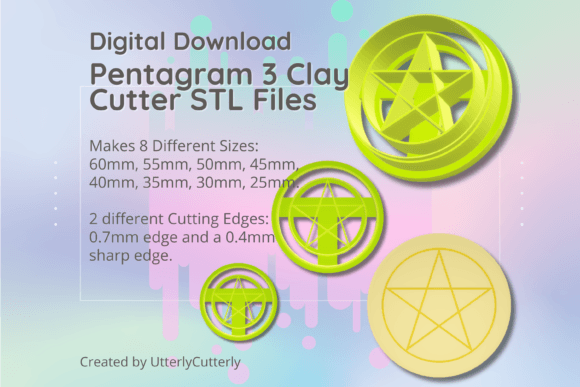
The first cutter type features a 0.7mm wall thickness with a 3mm thick base and a total height of 12mm. This profile is engineered primarily for durability and ease of post-processing. The slightly thicker wall provides rigidity during the cutting motion, preventing the pentagram points from flexing when pressed into firmer clay bodies. This configuration is ideal for:
- Polymer Clay Jewelry: Provides a clean cut that requires minimal sanding while maintaining enough structural strength to withstand repeated use.
- Ceramic and Air-Dry Clays: The robust wall resists deformation when cutting denser materials that offer higher resistance than polymer clay.
- Beginner Printing: The 0.7mm wall is more forgiving on standard FDM printers, reducing the risk of print failure due to nozzle clogs or layer adhesion issues common with ultra-thin walls.
The Sharp Edge (SE) Variant
Abbreviated as "SE" in the file naming convention, this variant utilizes a 1mm support wall that tapers down to a precise 0.4mm cutting edge. Like the standard version, it maintains a 3mm base and 12mm height for ergonomic handling. The Sharp Edge is specifically optimized for applications where surface finish and definition are paramount.
The 0.4mm edge slices through soft materials with significantly less drag, preserving delicate details in the pentagram design. This is particularly relevant for culinary uses; a thicker cutter can compress cookie dough, causing it to spread unevenly during baking. The SE variant ensures the baked good retains its intended whimsigoth silhouette. Similarly, when working with soft fondant or gum paste, the sharp edge prevents tearing and dragging, resulting in professional-grade cake decorations. Users should note that printing the SE variant requires a well-tuned printer capable of handling thin perimeters without compromising layer bonding.
Dimensional Scaling and Sizing Strategy
Versatility in maker projects often relies on having access to graduated sizes rather than a single dimension. The Clay Cutter STL File - Pentagram 3 bundle includes eight discrete sizes measured from the longest ends of the shape: 60mm, 55mm, 50mm, 45mm, 40mm, 35mm, 30mm, and 25mm. This range facilitates several practical workflows beyond simple resizing.
Jewelry Proportion and Set Creation
In jewelry design, scale dictates wearability. A 60mm pentagram may serve as a bold statement pendant or a large hair barrette, while the 25mm or 30mm versions are appropriate for lightweight earrings. Having intermediate sizes allows creators to build cohesive collections where pieces relate to one another proportionally. For example, a maker might use the 50mm cutter for a necklace focal point and the 35mm cutter for matching stud earrings, ensuring visual harmony across the set.
Culinary Presentation and Nesting
For bakers and confectioners, size variation enables dynamic plating and decoration. Larger cutters create main serving pieces, while smaller versions can be used for garnishes or tiered cake toppers. The ability to curate custom cutter combos means a baker can create a themed dessert table where every element shares the same pentagram motif at different scales, enhancing the overall aesthetic impact without requiring additional design work.
Embossing Compatibility and Clay Thickness
Many users utilize cutters not just for outlining shapes but also for creating texture. It is important to understand the relationship between cutter height and embossing depth. If the specific STL files in this pack include embossing lines, they are designed with a height of 10.5mm. Given that the total cutter height is 12mm, this leaves a 1.5mm clearance.
This specification serves as a functional guide for material preparation. To achieve a full impression without bottoming out or distorting the cutter frame, the clay must be conditioned to a thickness greater than 1.5mm. Working with clay thinner than this threshold risks the embosser hitting the work surface, which can damage both the print and the underlying mat. Conversely, using clay that is too thick may result in an incomplete impression if the user does not apply sufficient pressure. Adhering to this >1.5mm guideline ensures consistent texture transfer and protects the longevity of the 3D printed tool.
Additive Manufacturing Considerations for Cutters
While these STL files are designed to be easily printed, achieving optimal performance requires attention to slicer settings. The geometric complexity of a pentagram, with its acute angles and intersecting lines, presents unique challenges compared to simpler circular or oval cutters.
Orientation and Support
Cutters should always be printed with the cutting edge facing up and the base plate against the build surface. This orientation eliminates the need for supports inside the cutting channel, which are nearly impossible to remove cleanly and would ruin the blade's precision. The 3mm base provides ample surface area for bed adhesion, reducing warping risks even with materials like PLA or PETG.
Perimeter and Infill Settings
For the 0.7mm wall variant, setting the perimeter count to match the wall width exactly (typically two perimeters for a 0.4mm nozzle) ensures a solid, void-free blade. For the Sharp Edge (SE) variant, users may need to employ variable layer height or specialized thin-wall detection features in their slicer to ensure the 0.4mm tip prints reliably. Infill percentage is generally irrelevant for the cutting wall itself but should be sufficient in the base to prevent cracking under hand pressure. A gyroid or cubic infill pattern at 20-30% density typically offers the best balance of strength and print time for the handle portion.
Safety and Material Compliance
When utilizing these digital files for food-related applications such as cookies and fondant, safety protocols must be observed. Standard 3D printing filaments like PLA are generally considered non-toxic, but the layer lines inherent in FDM printing can harbor bacteria. Furthermore, brass nozzles may contain trace amounts of lead.
Professionals and hobbyists using the Clay Cutter STL File - Pentagram 3 for culinary purposes should treat the printed object as a prototype or single-use tool unless properly sealed. Food-safe epoxy coatings or specialized food-grade filament alternatives are recommended for repeated kitchen use. For polymer clay and other non-food crafts, standard PLA remains an excellent choice due to its stiffness and dimensional accuracy. Regardless of application, users should remember that this product is a digital download; the responsibility for safe manufacturing practices and material selection lies with the individual fabricating the physical tool.
Expanding the Digital Maker Ecosystem
This pentagram design is part of a broader ecosystem of weekly updated STL files. The advantage of digital inventory is the ability to mix and match designs without physical storage constraints. Creators can curate custom cutter combos by combining this pentagram set with other celestial, botanical, or gothic motifs available in the store. This modularity encourages experimentation; a maker might test a new earring design using the 30mm pentagram alongside a previously purchased moon phase cutter before committing to a full production run.
The continuous addition of new files ensures that makers can respond quickly to trending aesthetics. As the whimsigoth style evolves, having access to fresh, professionally modeled STL files allows small business owners and hobbyists to keep their product lines current without investing in expensive metal die manufacturing. By mastering the technical aspects of these specific pentagram cutters—from edge selection to sizing strategies—users unlock the full potential of digital fabrication for both artistic expression and commercial creation.