Clay Cutter STL File Ocean Sun 1: Technical Specifications and Practical Applications
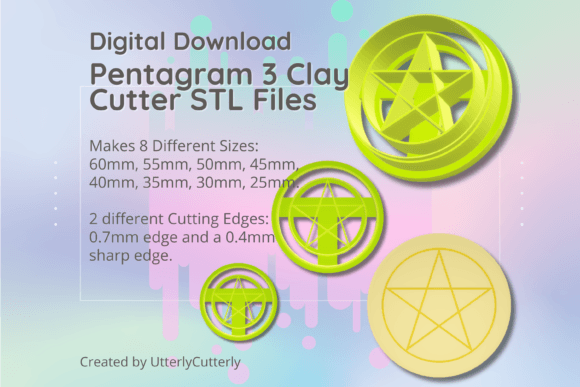
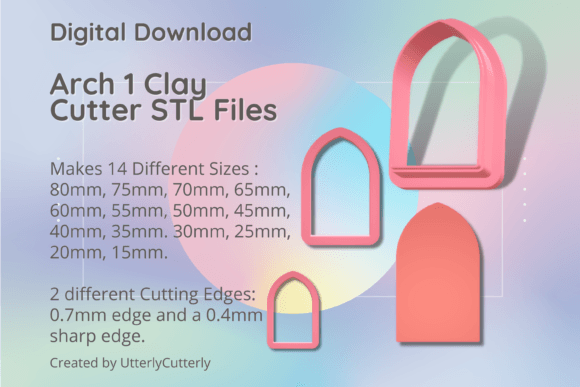
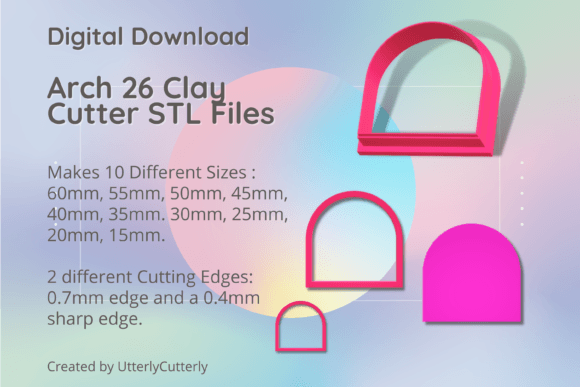
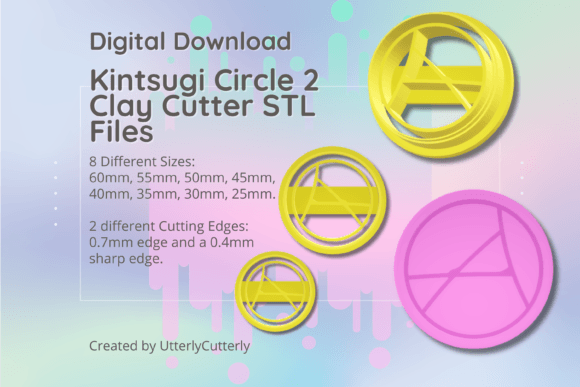
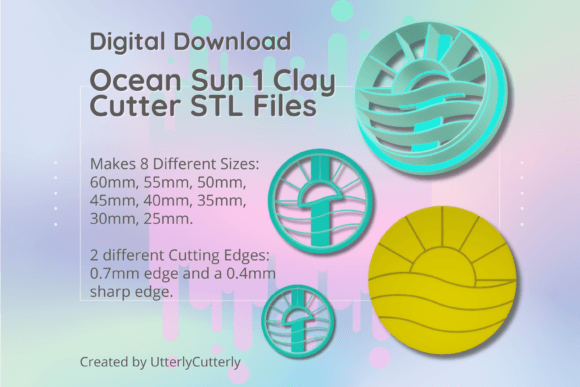
The Clay Cutter STL File Ocean Sun 1 represents a specific category of digital fabrication assets designed for polymer clay artists, bakers, and jewelry makers. Unlike physical tools shipped via mail, this product is a digital download containing stereolithography (STL) files optimized for FDM or resin 3D printing. The primary distinction of the Ocean Sun 1 bundle lies in its comprehensive sizing matrix and dual-edge configuration. Rather than offering a single static tool, this digital pack provides eight distinct sizes ranging from 25mm to 60mm, alongside two specialized cutting edge profiles. This variability allows users to curate custom sets based on their specific project requirements, whether creating delicate earring components or larger fondant decorations.
For makers evaluating digital cutter files against pre-made physical alternatives, the decision often hinges on customization versus convenience. While physical cutters offer immediate utility without hardware requirements, STL files like the Ocean Sun 1 provide long-term adaptability. Users can reprint damaged tools, adjust scaling slightly within slicer software, or produce multiple copies for production workflows. However, this flexibility requires access to a calibrated 3D printer and an understanding of print settings. Understanding the technical nuances of this specific file set is essential for determining if it aligns with your current production capabilities and artistic goals.
Evaluating Edge Profiles: Standard vs. Sharp Edge Variants
A critical factor in selecting the Clay Cutter STL File Ocean Sun 1 over generic alternatives is the inclusion of two distinct cutting geometries. Most basic STL files offer only one wall thickness, forcing users to compromise between durability and precision. This bundle addresses that limitation by providing both a standard robust profile and a specialized sharp edge variant.
The Standard 0.7mm Wall Configuration
The standard cutter in this pack features a 0.7mm wall thickness with a 3mm thick base and a total height of 12mm. This specification prioritizes structural integrity and ease of printing. A 0.7mm wall is generally compatible with standard 0.4mm nozzles without requiring extensive tuning, making it accessible for users with entry-level printers. This edge type is best suited for:
- Fondant and Cookie Work: The thicker edge compresses dough rather than slicing cleanly through it, which can be beneficial for sealing edges in filled cookies or preventing fondant from sticking to the blade.
- Beginner Polymer Clay Users: The wider surface area applies pressure more evenly across the clay, reducing the risk of distortion during the cutting motion.
- Durable Production Tools: For high-volume crafting where tools may experience accidental drops or heavy pressure, the 0.7mm wall resists snapping better than thinner variants.
The Sharp Edge (SE) Variant
Abbreviated as "SE" in the file names, the Sharp Edge variant utilizes a 1mm support wall tapering to a precise 0.4mm cutting edge. Despite having a supportive structure, the actual contact point is significantly finer than the standard version. This geometry mimics the performance of commercial metal cutters and is specifically engineered for detailed polymer clay work. Makers focusing on intricate jewelry, translucent clay techniques, or projects requiring minimal post-processing cleanup will find this variant superior. The tradeoff is printability; achieving a clean 0.4mm edge requires optimal cooling, proper flow calibration, and potentially a slower print speed to prevent layer shifting or blobbing at the tip.
Size Versatility and Project Scaling
The Ocean Sun 1 bundle includes eight incremental sizes: 25mm, 30mm, 35mm, 40mm, 45mm, 50mm, 55mm, and 60mm. Measurements are taken from the longest ends of the design. When comparing this to single-size downloads or fixed physical sets, the granular 5mm progression offers significant advantages in design composition.
In jewelry making, the difference between a 30mm and 35mm pendant can dictate chain selection and overall wearability. Having intermediate sizes allows artists to create graduated sets or nest designs without purchasing separate files. For cookie decorators, this range covers everything from small accent pieces to substantial centerpiece biscuits. It is important to note that while these files are scalable in slicer software, the provided sizes represent tested dimensions where the relationship between the cutting edge and the handle/base remains functional. Drastic upscaling may thin the walls relative to the size, while downscaling below 25mm could make the SE variant unprintable on standard hardware.
Embossing Compatibility and Material Constraints
Users must evaluate material thickness when utilizing the embossing features included in the Clay Cutter STL File Ocean Sun 1. Any embossing lines within this design are set to a height of 10.5mm. Given the total cutter height of 12mm, this leaves a clearance that necessitates working with clay thicker than 1.5mm.
This specification serves as a vital quality control parameter. If you typically condition and roll polymer clay to 1mm or less, the embossing detail may bottom out or fail to transfer clearly. In such cases, users would need to either increase their slab thickness or select a different cutter design with shallower relief. Conversely, for those working with air-dry clays or thicker ceramic slabs, this depth ensures crisp impression definition. Comparing this to shallow-emboss alternatives, the Ocean Sun 1 is better positioned for dimensional work rather than surface-texture-only applications.
Digital Assets vs. Physical Tools: Decision Factors
Choosing between downloading the Clay Cutter STL File Ocean Sun 1 and buying a physical equivalent involves assessing several practical variables. Neither option is universally superior; the right choice depends on your infrastructure and workflow.
When Digital STL Files Are the Better Fit
- Customization Needs: You require specific sizes not available commercially or wish to modify the design in CAD software before printing.
- Production Redundancy: You run a business where tool breakage causes downtime. Printing replacements on-demand eliminates shipping delays.
- Cost Efficiency at Scale: After the initial printer investment, the marginal cost per cutter is pennies in filament compared to $5-$15 per physical tool.
- Immediate Access: As a digital download, files are available instantly after payment, supporting spontaneous creative sessions without waiting for delivery.
When Physical Alternatives May Be Preferable
- No Hardware Access: You lack a 3D printer and do not wish to navigate print farms or local maker spaces.
- Metal Requirements: Your medium requires stainless steel for hygiene compliance (commercial food prep) or extreme durability that PLA/PETG cannot provide.
- Print Quality Sensitivity: You have experienced consistent issues with layer adhesion or bed leveling and prefer guaranteed consistency over DIY potential.
- Resale Value: Physical brass or steel cutters retain secondary market value, whereas printed plastic tools are generally consumables.
Technical Considerations for Successful Implementation
To maximize the utility of the Clay Cutter STL File Ocean Sun 1, users should approach printing with material science in mind. While the files are designed to be easily printed, "easy" is relative to machine calibration. Food-safe considerations are paramount if using these for cookies or fondant. Standard FDM prints have layer lines that can harbor bacteria; therefore, any culinary use requires either food-safe epoxy coating or dedicated usage with non-porous barriers like plastic wrap.
For polymer clay applications, material choice affects release properties. PETG and ABS tend to stick less to raw clay than PLA, though PLA remains the most common due to ease of printing. Applying a light dusting of cornstarch or water to the cutter rim can mitigate sticking regardless of material. Additionally, because the SE variant has a fine tip, users should consider printing with a brim to ensure first-layer adhesion, especially for the smaller 25mm and 30mm sizes where the footprint is minimal.
Ultimately, the Clay Cutter STL File Ocean Sun 1 serves as a versatile foundation for makers who value autonomy in their tooling. By offering dual edge profiles and a broad size spectrum, it bridges the gap between specialized jewelry tools and general-purpose craft supplies. Success with this digital asset depends less on the file itself and more on the user’s willingness to engage with the technical aspects of 3D printing and material compatibility. For those prepared to manage these variables, the ability to generate custom, precise cutting tools on demand offers a level of creative freedom that static physical products cannot match.