Arch Shape 7 Clay Cutter - Arc STL Digit: Precision Tools for Modern Makers
The landscape of small-scale manufacturing and artisanal craft has shifted dramatically with the accessibility of desktop 3D printing. For jewelry makers, ceramicists, and culinary artists, the ability to produce bespoke tools on demand is no longer a futuristic concept but a daily operational reality. The Arch Shape 7 Clay Cutter - Arc STL Digit represents this convergence of digital design and tactile creation. Rather than relying on mass-produced, limited-inventory metal cutters, creators can now access a comprehensive digital bundle of arch arc style clay cutters. This specific STL file package is engineered for immediate utility, offering a versatile range of designs that cater to both delicate jewelry fabrication and larger culinary applications.
This digital download is more than just a set of shapes; it is a foundational asset for makers who value autonomy in their workflow. By providing high-quality, print-ready files, we address the common friction points in 3D printed tooling: poor bed adhesion, fragile edges, and inconsistent sizing. Our cutters are designed to be easily printed, ensuring that even those new to additive manufacturing can achieve professional results. With new STL files arriving in our store every week, this system supports an evolving creative practice where your tool library grows alongside your artistic vision.
Technical Specifications and Print Optimization
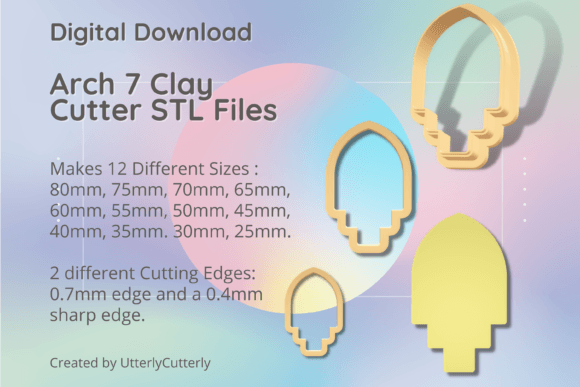
Understanding the technical nuances of cutter geometry is essential for successful prints and clean cuts. Generic STL files often fail because they do not account for the specific mechanics of slicing through polymer clay or dough. The Arch Shape 7 Clay Cutter - Arc STL Digit bundle mitigates these issues through two distinct cutting edge profiles included in every size variation. This dual-option approach acknowledges that different materials and finishing requirements demand different tool geometries.
- Standard Edge (0.7mm Wall): This profile features a 0.7mm wall thickness with a robust 3mm thick base and a total height of 12mm. It is designed for durability and ease of handling, making it ideal for general-purpose cutting where extreme sharpness is secondary to tool longevity and print reliability.
- Sharp Edge (SE): Abbreviated as SE in the file names, this variant includes a 1mm support wall tapering to a precise 0.4mm cutting edge. Like the standard version, it maintains a 3mm thick base and 12mm height. The SE profile is critical for detailed jewelry work or softer clays where minimizing drag and deformation during the cut is paramount.
Both profiles share a standardized 12mm height and 3mm base, which serves a functional purpose beyond structural integrity. The wide base ensures excellent bed adhesion during printing, reducing the risk of failed prints due to warping or detachment. Furthermore, the consistent height allows for ergonomic handling, providing enough surface area for the user to apply even pressure without discomfort. When embossing lines are present in specific designs, they are calibrated to be 10.5mm tall. This specific dimension requires users to work with clay thicker than 1.5mm to ensure the texture transfers fully without bottoming out, maintaining the crisp definition that distinguishes handmade pieces from factory alternatives.
Strategic Sizing for Versatile Applications
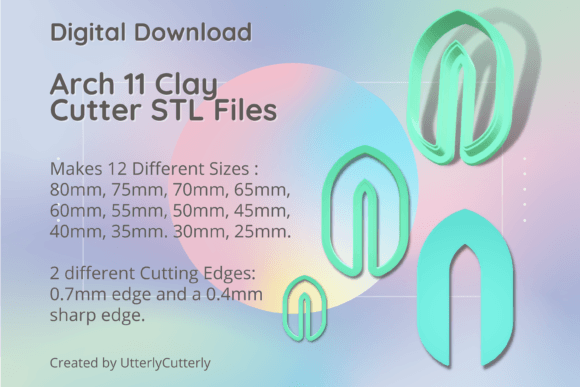
Versatility in maker tools is defined by granularity. A single size rarely suffices for professional production or complex artistic compositions. This bundle addresses that need by including 12 incremental sizes, measured from the longest ends of the arch. This graduated scaling allows for precise nesting, border creation, and proportional adjustments within a single project.
The available sizes in this combo pack are:
- 80mm
- 75mm
- 70mm
- 65mm
- 60mm
- 55mm
- 50mm
- 45mm
- 40mm
- 35mm
- 30mm
- 25mm
This 5mm increment step-down provides a logical progression for designers. For jewelry creators, the 25mm to 40mm range offers ideal dimensions for earrings, pendants, and ring bezels. Conversely, the 55mm to 80mm range transitions seamlessly into cookie decoration, tart shaping, or large-format ceramic tiles. Having all twelve sizes in one digital package eliminates the guesswork of sourcing complementary tools later. It enables makers to curate custom and unique cutter combos easily, especially when paired with other STL files from our expanding catalog. This modularity is key to developing a signature style; rather than being limited to whatever shapes a manufacturer decided to stock this season, you possess the complete spectrum of a specific form factor.
The Shift Toward Digital Tool Ownership
The transition from physical inventory to digital assets reflects broader changes in how independent businesses and hobbyists manage resources. Traditional supply chains for niche craft tools are often slow, expensive, and geographically restricted. If a specific arch cutter breaks or goes out of production, the maker is left scrambling. Digital ownership via STL files fundamentally alters this dynamic. When you acquire the Arch Shape 7 Clay Cutter - Arc STL Digit, you are securing perpetual access to the tool itself, not just a single instance of it.
This model aligns with modern sustainable practices and lean business methodologies. There is no shipping waste, no plastic packaging, and no waiting for international freight. Access to download the files is granted immediately after payment, allowing for instant integration into active projects. For entrepreneurs running made-to-order shops, this immediacy is a competitive advantage. If a client requests a slight variation in size or a replacement for a worn tool, the solution is a thirty-minute print job rather than a two-week procurement cycle.
Furthermore, digital files allow for material experimentation. A maker can print the Sharp Edge version in PLA for biodegradable prototyping, then switch to PETG or ABS for food-safe durability or solvent resistance, all from the same source file. This flexibility encourages testing and iteration that would be cost-prohibitive with pre-manufactured metal cutters. The low marginal cost of producing additional units means that wear and tear is no longer a source of anxiety; tools become consumable components of the creative process rather than precious heirlooms to be guarded.
Practical Considerations for Makers and Businesses
While the advantages of STL-based tooling are significant, successful implementation requires attention to detail. Users must recognize that this is not a physical item; the value lies entirely in the digital data and the user's ability to fabricate it. Ensuring your 3D printer is properly calibrated is the first step. Because these cutters feature thin walls (especially the 0.4mm SE variant), nozzle diameter and flow rate calibration are critical. A standard 0.4mm nozzle is recommended for the Sharp Edge files to accurately reproduce the cutting geometry, while the Standard Edge files are more forgiving and can often be printed successfully with 0.6mm nozzles for faster production.
For those using these cutters in commercial food preparation, material safety is paramount. While the STL files provide the geometry, the user is responsible for selecting food-safe filaments and post-processing methods. Layer lines in 3D prints can harbor bacteria, so sealing printed cookie cutters with appropriate food-grade epoxy or using them exclusively with single-use barriers is a necessary best practice. In contrast, polymer clay users should focus on release agents; the smooth finish of well-tuned prints usually releases cleanly from conditioned clay, but a light dusting of cornstarch or spray of water can prevent sticking in intricate arch designs.
Business owners and educators should also consider the organizational aspect of digital libraries. With new STL files coming to our store every week, establishing a systematic file management protocol early prevents future confusion. Naming conventions, version control, and print setting documentation ensure that your team or students can replicate results consistently. The Arch Shape 7 bundle is designed to integrate into such systems, with clear labeling distinguishing between Standard and SE variants across all twelve sizes.
Evolving Creative Workflows Through Modular Design
The true power of the Arch Shape 7 Clay Cutter - Arc STL Digit emerges when viewed as part of a larger ecosystem. Modern making is increasingly modular; creators mix and match components to generate novelty. An arch shape is rarely used in isolation. It might be combined with floral elements, geometric frames, or textural stamps to create a composite design. By standardizing sizing increments and maintaining consistent base heights across our entire catalog, we facilitate this combinatorial creativity.
This approach mirrors trends in software development and parametric design, where interoperability drives innovation. When your tools speak the same dimensional language, experimentation becomes frictionless. You can test whether a 40mm arch nests perfectly inside a 50mm frame from a different pack, or if three 30mm arches create a pleasing scalloped border. This level of intentional curation was previously impossible without custom machining. Now, it is accessible to anyone with a desktop printer and a willingness to explore.
Ultimately, investing in high-quality digital cutter files is an investment in creative agency. It removes the constraints of availability and replaces them with the possibilities of fabrication. Whether you are producing hundreds of uniform cookies for a seasonal market or crafting one-of-a-kind porcelain earrings, having the exact right tool at the exact right moment transforms the quality of your output and the efficiency of your practice. The Arch Shape 7 bundle provides that precision, packaged for the realities of contemporary digital craftsmanship.