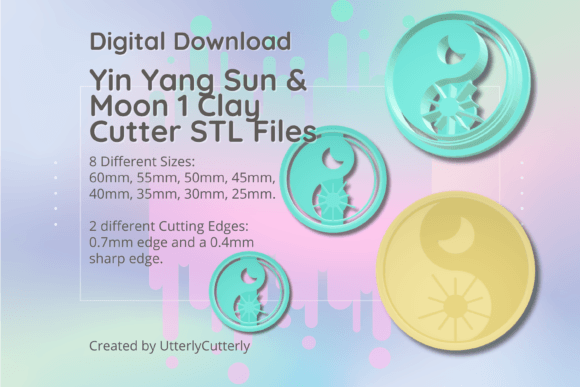
Yin Yang Sun and Moon 1 Clay Cutter - ST: Digital Precision for Modern Makers
The intersection of ancient symbolism and modern manufacturing has created a unique niche in the handmade jewelry market. The Yin Yang Sun and Moon 1 Clay Cutter - ST represents more than just a tool; it is a digital asset that empowers creators to produce culturally resonant, aesthetically balanced accessories with professional consistency. As the maker economy matures, the reliance on high-quality, printable STL files has shifted from a novelty to a fundamental business requirement for polymer clay artists and small-scale jewelers.
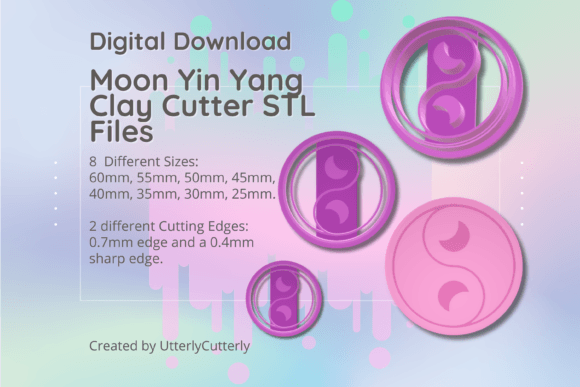
This specific digital download bundle offers a comprehensive solution for artisans looking to integrate celestial motifs into their collections. By providing eight distinct sizes and two specialized cutting edge profiles, this file set addresses the practical realities of earring design. It moves beyond generic shapes to offer technical versatility that supports both delicate stud earrings and substantial statement pieces. For entrepreneurs and hobbyists alike, understanding the specifications and applications of these digital tools is essential for maximizing print quality and final product appeal.
The Shift Toward Digital-First Craftsmanship
In recent years, the polymer clay community has undergone a significant transformation regarding tool acquisition. Historically, makers relied on mass-produced metal cutters or hand-carved tools that offered limited variation. Today, the workflow is increasingly digital-first. Creators now prefer owning the source files for their tools rather than waiting for physical shipping. This shift aligns with broader trends in decentralized production and on-demand manufacturing.
The Yin Yang Sun and Moon 1 Clay Cutter - ST exemplifies this evolution. By utilizing a digital STL format, makers gain immediate access to production capabilities without supply chain delays. This immediacy is crucial for trend-responsive businesses. When celestial aesthetics or balance-themed jewelry sees a surge in social media engagement, having the file ready to print allows creators to capitalize on market interest instantly. Furthermore, digital ownership eliminates the risk of discontinued products; as long as you have the file and a functioning 3D printer, your production line remains active.
This model also supports sustainable practices within the crafting industry. Instead of importing plastic tools from overseas, makers can print exactly what they need using biodegradable PLA or recycled filaments. The ability to curate custom cutter combos easily with other STL files fosters a modular approach to design, reducing waste and encouraging experimentation without significant financial overhead.
Technical Specifications and Print Optimization
Success in 3D printed clay tools depends entirely on understanding technical tolerances. A poorly sliced file results in rough edges, clay sticking, or structural failure during use. This bundle is engineered with specific parameters to mitigate these common issues, but users must select the correct variant for their intended application.
Understanding Edge Profiles
The inclusion of two distinct cutter types acknowledges that not all clay projects require the same finish. Selecting the appropriate profile is critical for workflow efficiency:
- Standard Edge (0.7mm Wall): This variant features a 0.7mm wall thickness with a 3mm thick base and a total height of 12mm. It is designed for durability and general-purpose cutting. The thicker wall provides rigidity, preventing the cutter from flexing when pressed into firmer clay or cookie dough. This is often the preferred choice for beginners or for creating textured cookies where extreme sharpness is less critical than tool longevity.
- Sharp Edge (SE): Abbreviated as SE in the file names, this version utilizes a 1mm support wall tapering to a precise 0.4mm cutting edge. Like the standard version, it maintains a 3mm base and 12mm height. The reduced contact surface area significantly decreases resistance, allowing for cleaner cuts in soft polymer clay. This profile minimizes dragging and distortion, which is vital for intricate yin yang details where symmetry defines the aesthetic value.
For jewelry makers focusing on high-end finishes, the Sharp Edge variant typically reduces post-processing time. Less sanding is required when the initial cut is clean, directly impacting profit margins and production speed.
Size Versatility and Embossing Considerations
Versatility is a key driver for digital tool adoption. This pack includes eight graduated sizes measured from the longest ends: 60mm, 55mm, 50mm, 45mm, 40mm, 35mm, 30mm, and 25mm. This range facilitates cohesive collection building. A creator might use the 60mm size for pendant bases while utilizing the 25mm and 30mm variants for matching stud earrings.
Users should note specific constraints regarding embossing lines. If the design includes raised detailing, these lines are 10.5mm tall. Consequently, effective embossing requires clay conditioned to a thickness greater than 1.5mm. Attempting to emboss thinner sheets will result in incomplete impressions or clay tearing. Understanding this dimensional relationship prevents material waste and ensures professional results.
Integrating Celestial Motifs into Contemporary Design
The yin yang symbol, paired with sun and moon iconography, occupies a stable position in jewelry trends due to its dual nature. It appeals to consumers seeking spiritual meaning as well as those drawn to geometric balance. However, market saturation means that execution matters more than the concept itself. High-resolution, crisp cuts distinguish premium handmade goods from amateur attempts.
Digital cutters like the Yin Yang Sun and Moon 1 Clay Cutter - ST enable a level of precision that is difficult to achieve by hand. The mathematical symmetry inherent in STL files ensures that every pair of earrings is identical, a non-negotiable standard for retail sales. Moreover, the ability to mix these files with new STL designs released weekly allows makers to evolve their style continuously. One week might feature minimalist yin yang studs, while the next incorporates celestial elements into complex layered pendants.
For educators and workshop leaders, these standardized digital tools provide a reliable teaching aid. Students can focus on technique and assembly rather than struggling with inconsistent hand-cut shapes. This consistency elevates the perceived value of educational content and student outcomes.
Practical Workflow Recommendations
To maximize the utility of this digital download, consider the following operational best practices:
- File Management: Organize your STL library by theme and edge type. Clearly labeling "SE" versus standard files prevents printing errors. Since this is a digital-only product, maintaining a backup of your purchased files is essential for long-term business continuity.
- Slicer Settings: Adjust your slicer based on the selected edge type. Sharp Edge variants may benefit from slower outer wall speeds to preserve the fine 0.4mm tip. Standard edges can generally be printed at higher speeds. Always use adequate brims or rafts if bed adhesion is an issue, as the 3mm base provides good surface area but small cutters can still detach.
- Material Selection: While these cutters work beautifully with polymer clay, the robust 12mm height and 3mm base also make them suitable for cookie dough. However, dedicate separate printers or thoroughly sanitize tools if switching between food-safe and craft applications. For clay, applying a light dusting of cornstarch or water to the blade before cutting enhances release, especially with the SE profile.
- Iterative Testing: Before committing to a full production run, print one test cutter. Verify the fit against your preferred earring hardware and check the embossing depth against your standard clay conditioning settings. Digital fabrication allows for rapid iteration; if a size feels too large for current trends, simply print the next size down immediately.
The Future of Custom Tooling
The availability of specialized digital assets like the Yin Yang Sun and Moon 1 Clay Cutter - ST signals a maturing ecosystem for independent creators. We are moving away from passive consumption of tools toward active participation in tool creation and customization. As 3D printing technology becomes more accessible and filament materials improve, the gap between digital design and physical product continues to narrow.
For the modern maker, success lies in leveraging these technologies to enhance, not replace, artistic vision. These cutters handle the repetitive precision work, freeing the artist to focus on color blending, surface treatment, and brand storytelling. By integrating high-quality STL files into your workflow, you build a scalable foundation that supports creative growth and business resilience. Whether you are producing bespoke jewelry for clients or baking themed treats for events, the right digital tool transforms potential friction into seamless creation.