Mastering Polymer Clay Jewelry: A Guide to Geometric Earring 3D Printed Cutters
In the rapidly evolving world of handmade jewelry and polymer clay artistry, precision and consistency are the hallmarks of professional-quality work. While hand-cutting shapes offers a certain organic charm, modern makers increasingly rely on digital fabrication to elevate their craft. The Geometric Earring 3 Clay Cutter STL Digital Download represents a pivotal intersection between traditional craftsmanship and modern technology. This comprehensive bundle is not merely a set of tools; it is a gateway to scalable creativity, offering artisans the ability to produce versatile, geometric designs with exacting accuracy.
Understanding how to leverage these digital assets requires more than just owning a 3D printer. It involves grasping the nuances of file types, cutting edge mechanics, and sizing strategies that transform a simple STL file into a stunning pair of earrings or a perfectly shaped cookie. Whether you are a seasoned jeweler looking to streamline production or a hobbyist exploring the possibilities of additive manufacturing, this guide will walk you through everything you need to know about utilizing geometric clay cutter bundles effectively.
The Significance of Digital STL Files in Modern Craft
To fully appreciate the value of this cutter bundle, one must first understand the shift from physical inventory to digital libraries. An STL (Standard Tessellation Language) file is the industry standard for 3D printing, describing the surface geometry of a three-dimensional object. When you purchase a digital download rather than a physical product, you are acquiring the blueprint for infinite reproduction.
This model fits seamlessly into modern creative workflows for several reasons:
- Instant Access: There is no shipping delay. Once payment is processed, the files are immediately available for download, allowing inspiration to strike without logistical friction.
- Customizability: Unlike mass-produced plastic cutters, digital files allow you to curate custom combos. You can print specific sizes on demand based on current trends or client requests.
- Sustainability and Economy: You only use the filament necessary for the tools you actually need, reducing waste and eliminating the carbon footprint associated with shipping physical goods globally.
- Continuous Innovation: With new STL files added to stores weekly, your toolkit evolves alongside design trends without requiring additional storage space for physical items.
Decoding the Bundle: Sizes and Versatility
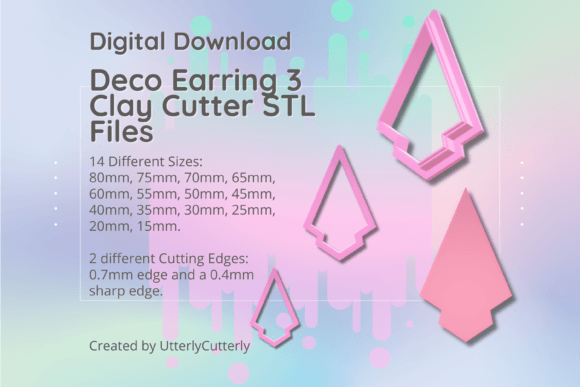
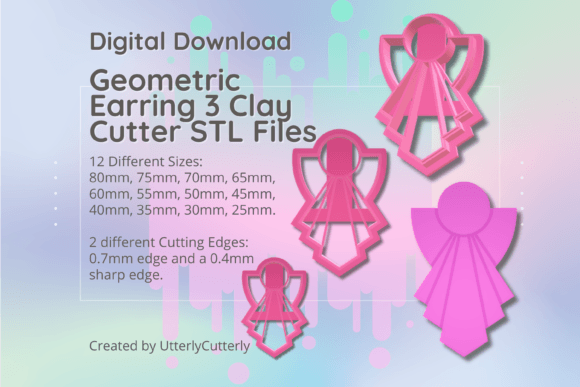
A common misconception among beginners is that a single cutter size suffices for all projects. However, professional jewelry making relies heavily on proportion and scale. This specific geometric earring pack addresses that need by providing 12 different sizes, ensuring versatility across various applications.
Cutter size is always measured from the longest ends of the shape. In this comprehensive bundle, the sizes are meticulously graduated to allow for nesting designs, graduated earring sets, or scaling for different age groups. The included dimensions are:
- 80mm – Ideal for statement pieces or large cookie decorations.
- 75mm
- 70mm
- 65mm
- 60mm
- 55mm
- 50mm – A popular standard for bold everyday earrings.
- 45mm
- 40mm
- 35mm
- 30mm – Perfect for delicate studs or children’s jewelry.
- 25mm – Excellent for accent charms or miniature details.
Having this range at your fingertips allows you to experiment with visual weight. For example, pairing an 80mm geometric shape with a 30mm counterpart creates a dynamic, asymmetrical earring design that feels intentional and high-end. Furthermore, because these are digital files, you can easily integrate them with other STL packs to create complex, multi-layered compositions.
Technical Specifications: Choosing Your Cutting Edge
Perhaps the most critical aspect of this digital bundle is the inclusion of two distinct cutting edge types. Not all clay behaves the same way, and not all aesthetic goals require the same tool. Understanding the difference between the Standard Wall and the Sharp Edge (SE) variants is essential for achieving clean results.
The Standard Wall Cutter
This variant features a 0.7mm wall thickness with a 3mm thick base and a total height of 12mm. This is the workhorse of polymer clay cutting. The slightly thicker wall provides rigidity, preventing the cutter from warping when pressing into firmer clays. It produces a clean cut with a very slight rounded edge, which is often desirable for jewelry as it reduces the need for extensive sanding post-bake. This type is recommended for general earring making, especially when structural integrity during the cutting process is paramount.
The Sharp Edge (SE) Cutter
Abbreviated as "SE" in the file names, this version boasts a 1mm support wall with a razor-thin 0.4mm cutting edge. Like the standard version, it maintains a 3mm thick base and 12mm height for ease of handling. The SE cutter is designed for precision. It slices through clay with minimal resistance, resulting in crisp, defined edges that mimic the look of die-cut metal. This is particularly useful for intricate geometric patterns where edge definition defines the aesthetic. However, users should note that the thinner edge requires a gentler touch to avoid bending the blade on extremely hard clay.
Navigating Embossing and Clay Thickness
Many geometric cutters serve a dual purpose: cutting the outline and embossing internal details. It is vital to understand the relationship between the tool's depth and your material's thickness. If this STL pack includes embossing lines, they are designed to be 10.5mm tall.
This specification carries a practical implication: you must work with clay thicker than 1.5mm. If your clay slab is thinner than this threshold, the embosser may penetrate completely through the material, ruining the piece. Always condition and roll your clay to a consistent thickness exceeding 1.5mm before using embossing features. This ensures the design is pressed into the surface rather than cutting through it, preserving the structural integrity of the earring or cookie.
Best Practices for 3D Printing Jewelry Tools
Owning the STL file is only half the equation; successful printing determines the tool's performance. These cutters are designed to be easily printed, but adhering to best practices ensures longevity and safety.
- Material Safety: Always use food-safe or non-toxic PLA/PETG filaments if you intend to use these cutters for cookies. For polymer clay exclusively, standard PLA is generally sufficient, but PETG offers higher heat resistance and durability.
- Layer Height: Print at a lower layer height (0.12mm to 0.16mm) for the cutting edges. Smoother layers translate directly to smoother cuts in your clay, reducing post-processing time.
- Infill and Walls: While the base is 3mm thick, ensure your slicer settings respect the wall thickness definitions in the STL. Increasing perimeter walls can add strength to the SE variants without altering the cutting geometry.
- Post-Processing: Even with optimal print settings, 3D printed tools may have minor layer lines. Lightly sanding the cutting edge with fine-grit sandpaper can significantly improve performance, especially for the Standard Wall variant.
Expanding Your Creative Horizons
The true power of digital cutter bundles lies in their interoperability. Because cutter size is standardized and measured consistently, you can confidently mix and match files from different packs. A geometric earring cutter might pair beautifully with a floral texture stamp or a complementary arch shape from another collection. This modularity encourages experimentation, allowing makers to develop signature styles that cannot be replicated with generic, store-bought tools.
Moreover, the educational value of using customizable tools cannot be overstated. Makers learn about tolerance, material behavior, and digital design principles simply by engaging with these files. As new STL files are released weekly, staying engaged with the digital marketplace keeps your skills sharp and your product line fresh.
Important Considerations for Buyers
Before purchasing, it is crucial to reiterate that this is not a physical item. You will not receive plastic cutters in the mail. Instead, you gain immediate access to high-quality digital files after payment. Ensure you have access to a functioning 3D printer or a local printing service before buying. Additionally, familiarize yourself with your printer’s bed adhesion and calibration, as small, detailed objects like jewelry cutters require a well-tuned machine.
By embracing digital fabrication through bundles like the Geometric Earring 3 Clay Cutter STL pack, artisans bridge the gap between artisanal tradition and technological innovation. Whether creating bespoke jewelry or decorative edibles, these tools offer the precision, variety, and flexibility needed to thrive in today’s maker economy. With 12 sizes, two edge profiles, and endless creative potential, this digital download is an essential asset for any serious creator looking to curate unique, professional-grade combinations.