Geometric Diamond 1 Clay Cutter: Mid Ce STL Guide
Achieving consistent, professional results in polymer clay jewelry or detailed cookie decorating often comes down to the precision of your tools. The Geometric Diamond 1 Clay Cutter - Mid Ce offers a digital solution for creators who own 3D printers and require specific, reliable geometries. Rather than relying on mass-produced plastic cutters that may warp or lack size variety, this digital STL bundle allows you to manufacture your own high-quality tools on demand. By providing ten distinct sizes and two specialized cutting edge profiles, this file set addresses the practical needs of makers who value versatility and exactness in their craft.
Understanding Dual Edge Profiles for Material Versatility
One of the most significant advantages of this digital download is the inclusion of two distinct cutter types within the same geometric design. Understanding the difference between these profiles is essential for selecting the right tool for your specific medium, whether you are working with soft polymer clay, fondant, or cookie dough.
The Standard 0.7mm Wall Profile
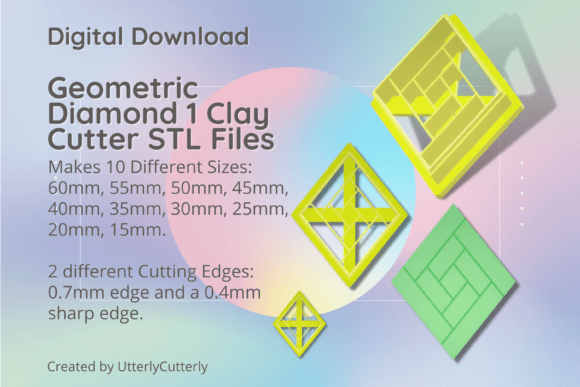
The standard version features a 0.7mm wall thickness with a 3mm thick base and a total height of 12mm. This profile is engineered for durability and ease of printing. The thicker wall provides structural rigidity, making it less prone to bending during use. This is particularly beneficial when working with stiffer clays or when applying significant downward pressure. The 3mm base offers a comfortable grip surface, reducing hand fatigue during long production sessions. For general-purpose shaping where an ultra-fine edge is not critical, this profile offers a robust balance of longevity and performance.
The Sharp Edge (SE) Profile
For applications requiring cleaner cuts and finer detail, the bundle includes the Sharp Edge variant, abbreviated as SE in the file names. This version maintains the same 3mm base and 12mm height but utilizes a 1mm support wall tapering to a precise 0.4mm cutting edge. This reduced contact area slices through material with less resistance, resulting in smoother edges that require minimal post-processing. Jewelry makers will find this profile invaluable for creating components that need little to no sanding after baking. When working with delicate materials like gum paste or thin polymer sheets, the SE profile prevents dragging and distortion, preserving the integrity of the geometric diamond shape.
Strategic Sizing for Cohesive Design Systems
Creative projects rarely exist in isolation; they are often part of a larger collection or product line. Having access to a graduated range of sizes allows for better design hierarchy and visual cohesion. The Geometric Diamond 1 Clay Cutter - Mid Ce pack includes ten incremental sizes measured from the longest ends: 60mm, 55mm, 50mm, 45mm, 40mm, 35mm, 30mm, 25mm, 20mm, and 15mm.
This comprehensive sizing strategy solves several common production challenges:
- Nesting Capabilities: The consistent 5mm increments allow smaller diamonds to nest perfectly within larger ones, facilitating the creation of framed designs or layered jewelry components without manual measurement errors.
- Product Line Scalability: Entrepreneurs can offer the same design in multiple formats, such as statement earrings at 60mm and subtle studs at 15mm, using identical geometry to maintain brand consistency.
- Material Optimization: Smaller sizes allow you to utilize clay scraps efficiently, reducing waste during prototyping or small-batch production.
- Mix-and-Match Potential: These standardized sizes are designed to integrate with other STL files in our store, enabling you to curate custom cutter combos that share compatible dimensions.
Technical Considerations for Embossing and Print Success
While the primary function of these files is cutting, users should be aware of specific dimensional constraints regarding embossing features. If the selected design includes embossing lines, they are set at a height of 10.5mm. Given the total cutter height of 12mm, this leaves only 1.5mm of clearance above the embossed feature.
This specification dictates material preparation. To achieve a clear impression without bottoming out or distorting the cutter, you must work with clay or dough thicker than 1.5mm. Attempting to emboss thinner material will result in incomplete impressions or potential damage to the printed tool. Always condition your polymer clay to a uniform thickness exceeding this minimum before using embossing variants. For non-embossing cutting tasks, standard thickness guidelines for your specific medium apply.
From a 3D printing perspective, these cutters are optimized for FDM printers. The 3mm base ensures strong bed adhesion, while the vertical walls print efficiently without excessive supports. However, print orientation matters. Always print the cutter standing upright on its base to ensure the cutting edge remains crisp and layer lines run vertically along the wall rather than horizontally across the blade. Using a standard 0.4mm nozzle with at least three perimeters is recommended to achieve the intended wall strength for both the standard and SE profiles.
Who Benefits Most From Digital Cutter Files?
Digital STL files represent a shift from consuming physical goods to manufacturing tools locally. This model serves specific user groups more effectively than traditional retail options:
- Jewelry Designers: Professionals who need repeatable, precise shapes for production runs benefit from the ability to reprint worn tools instantly rather than waiting for shipping.
- Educators and Workshop Leaders: Instructors can provide every student with identical tools by printing a class set overnight, ensuring consistent learning outcomes.
- Small Business Owners: Makers selling on platforms like Etsy can rapidly prototype new designs without investing in expensive custom metal dies or bulk plastic orders.
- Hobbyists with Limited Storage: Digital libraries take up zero physical space, allowing collectors to maintain hundreds of cutter designs without cluttering their workspace.
Maximizing Value Through Local Manufacturing
Purchasing the Geometric Diamond 1 Clay Cutter - Mid Ce as a digital download eliminates the uncertainties associated with international shipping and inventory shortages. You gain immediate access to tested, production-ready files upon payment completion. This immediacy supports agile creative workflows where inspiration strikes unexpectedly or client deadlines are tight.
Furthermore, owning the source files grants you autonomy over tool maintenance. Physical cutters eventually degrade; plastic warps, edges dull, and accidental drops cause cracks. With STL files, replacement is simply a matter of loading the file into your slicer and pressing print. This sustainability aspect reduces long-term costs and waste, aligning with the values of many modern makers who prefer repairable and reproducible tools over disposable alternatives.
When integrating these cutters into your workflow, remember that digital fabrication requires initial calibration. Test print one size first to verify dimensional accuracy and edge quality on your specific printer before committing to the full set. Different filaments behave differently; PLA offers stiffness suitable for most clay work, while PETG may provide additional flexibility for complex demolding scenarios. By understanding both the digital specifications and your hardware capabilities, you transform a simple geometric shape into a cornerstone of efficient, professional-grade creation.