Half Circle 4 Clay Cutter Arc STL Digital Download
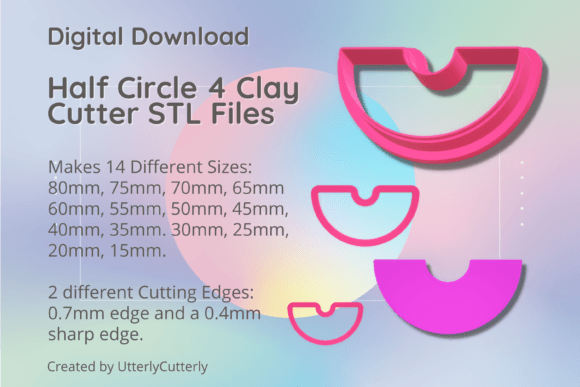
Creating consistent, professional-grade polymer clay jewelry often comes down to having the right tools at your fingertips. The Half Circle 4 Clay Cutter - Arc STL Digi provides a comprehensive digital solution for makers who want to print their own high-quality shaping tools. This digital download includes fourteen distinct sizes and two specialized cutting edge profiles, allowing you to produce everything from delicate earring components to substantial pendant bases directly from your home 3D printer. Rather than waiting for shipping or settling for limited retail options, this STL bundle puts manufacturing control directly into your hands.
Versatility Across Skill Levels and Goals
Digital fabrication files serve different purposes depending on where you are in your creative journey. For a hobbyist just starting with polymer clay, the primary value lies in accessibility and low-risk experimentation. Purchasing physical cutters can become expensive when you are still discovering your preferred style. With the Half Circle 4 Clay Cutter - Arc STL Digi, beginners can print a single test size to practice their technique before committing to a full set. The ability to print replacements instantly also removes the anxiety of breaking a favorite tool during the learning process.
Professional jewelers and small business owners approach these files with a different set of priorities. For commercial creators, consistency is non-negotiable. Customers expect matching earrings to be identical, and hand-cutting arcs freehand rarely achieves the precision required for retail sales. This digital pack ensures that every piece produced maintains exact dimensional accuracy. Furthermore, the ability to curate custom cutter combos allows established brands to develop signature silhouettes that cannot be easily replicated by competitors using generic store-bought tools. The cost-per-unit for printed cutters is negligible, protecting profit margins even when prototyping new collections.
Educators and workshop facilitators will find unique utility in the scalable nature of this design. Teaching clay techniques often requires demonstrating how scale affects visual weight and wearability. Having access to sizes ranging from 15mm to 80mm allows instructors to show students the dramatic difference a few millimeters can make in a finished piece. Instead of asking students to purchase expensive individual tools, educators can print class sets tailored specifically to the lesson plan, ensuring everyone has the correct equipment without financial barriers.
Understanding the Technical Specifications
Selecting the right file variant is essential for achieving clean cuts and preserving your clay. This bundle includes two distinct cutter types designed for specific applications. Understanding the difference prevents frustration and material waste.
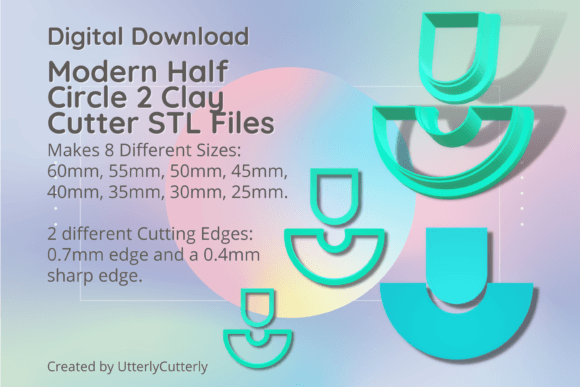
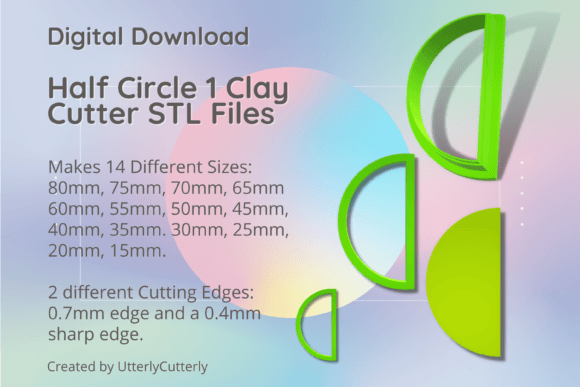
- Standard Wall (0.7mm): This version features a 0.7mm wall thickness with a 3mm thick base and a total height of 12mm. It offers increased rigidity and durability, making it ideal for firmer clays or repetitive production work where tool flex must be minimized.
- Sharp Edge (SE): Abbreviated as SE in the file names, this variant uses a 1mm support wall tapering to a precise 0.4mm cutting edge. Like the standard version, it has a 3mm base and 12mm height. The sharper profile slices through soft or sticky clays with less resistance, reducing drag marks and deformation on delicate pieces.
The size range covers significant ground for jewelry design. The fourteen included sizes are measured from the longest ends: 80mm, 75mm, 70mm, 65mm, 60mm, 55mm, 50mm, 45mm, 40mm, 35mm, 30mm, 25mm, 20mm, and 15mm. This granular progression allows for nuanced sizing adjustments that pre-manufactured sets rarely offer. Whether you are creating a graduated necklace stack or sizing barrettes for different hair volumes, the incremental steps provide necessary flexibility.
Embossing and Clay Thickness Considerations
Users planning to incorporate texture should note the embossing line specifications. Any embossing lines included in the design stand 10.5mm tall. To achieve a clear impression without bottoming out or distorting the clay structure, you must work with clay thicker than 1.5mm. Attempting to emboss thinner sheets may result in tearing or incomplete patterns. This specification is particularly relevant for creators making pendants or brooches where structural integrity and surface detail are equally important.
Practical Applications for Jewelry and Beyond
While primarily marketed for jewelry, the half-circle arc geometry serves multiple creative functions. Earring makers frequently use the smaller sizes (15mm–35mm) to create lightweight, comfortable studs and dangles. The sharp edge variant excels here, producing clean edges that require minimal sanding post-bake. For pendant necklaces and brooches, the mid-to-large range (40mm–80mm) provides ample canvas for color blending, mica shifts, or embedded elements.
Hair accessory creators benefit from the larger dimensions and the sturdy standard wall construction. Hair barrettes and clips endure significant mechanical stress, so using the more rigid 0.7mm wall cutter helps ensure the clay slab is compressed evenly during cutting, contributing to a stronger final product after curing. Beyond adornment, some users adapt these arcs for cookie decorating, particularly when working with fondant or gum paste for cake design. The food-safe nature of PLA plastic (when printed correctly and used appropriately) opens crossover potential for culinary artists, though dedicated food-use printers are always recommended for safety.
Evaluating Fit for Your Workflow
Before downloading, consider whether digital fabrication aligns with your current setup. This is strictly a digital STL file; no physical item will be shipped. You need access to a functioning 3D printer and basic slicing software to utilize this product. If you lack printing capabilities, local maker spaces or online printing services can bridge the gap, though this adds lead time and cost.
For those with existing printers, evaluate your machine’s calibration. Fine details like the 0.4mm sharp edge require proper nozzle tuning and bed adhesion. Users with older or poorly maintained printers may achieve better results with the standard 0.7mm wall variant, which is more forgiving of minor calibration issues. New STL files are added to the store weekly, suggesting an ecosystem approach; if you value expanding your tool library over time rather than buying static sets, this subscription-adjacent model supports ongoing creative development.
Ultimately, the Half Circle 4 Clay Cutter - Arc STL Digi represents a shift toward decentralized toolmaking. It empowers creators to solve specific design problems immediately rather than adapting their vision to available inventory. Whether you prioritize speed, customization, educational value, or commercial scalability, owning the source files transforms how you interact with your craft. Assess your typical project dimensions, clay preferences, and production volume to determine which cutter variant and sizes will deliver the most immediate impact on your work.