Elevating Handmade Production with the Circle Window 2 Clay Cutter STL Digital Download
The landscape of small-scale manufacturing and artisanal craft is undergoing a significant transformation, driven by the convergence of traditional hand skills and accessible digital fabrication. For professionals, creators, and entrepreneurs in the polymer clay, ceramic, and bespoke confectionery sectors, the ability to iterate designs quickly and maintain consistent quality is paramount. This shift has elevated the importance of precision digital assets like the Circle Window 2 Clay Cutter - STL Digital download. Far more than a simple shaping tool, this digital asset represents a strategic component in a modern maker’s workflow, bridging the gap between creative vision and scalable production.
In an industry where uniqueness is the primary value proposition, reliance on mass-produced, generic tools often limits artistic expression and market differentiation. The transition to user-printed, customizable tooling addresses this bottleneck directly. By utilizing high-quality STL files, creators are no longer passive consumers of hardware; they become active participants in their toolchain's design and optimization. This article explores how integrating specific digital cutter libraries into your practice aligns with broader trends in decentralized manufacturing, sustainable production, and the evolving expectations of the handmade marketplace.
The Shift Toward Decentralized Tool Manufacturing
Historically, acquiring specialized clay or cookie cutters involved navigating supply chains characterized by long lead times, minimum order quantities, and limited design variety. If a jeweler needed a specific 45mm window frame for a new collection, they were often forced to compromise on size or wait weeks for shipping. The availability of comprehensive digital bundles disrupts this legacy model. When you acquire a bundle of circle window style clay cutters as a digital download, you are effectively insourcing your tool production.
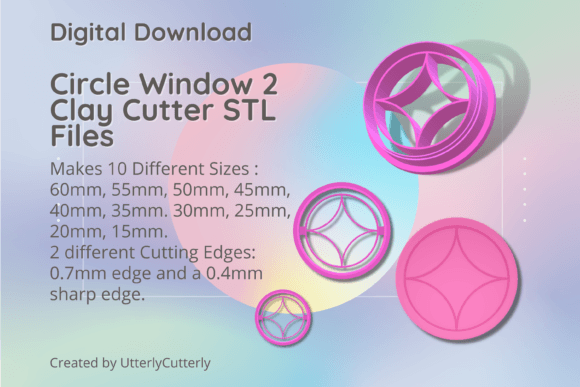
This decentralization is critical for agile businesses. Market trends in handmade goods move rapidly; what is popular on social media platforms today may be saturated next month. Creators who can download, print, and test new designs within hours possess a competitive advantage over those tethered to traditional suppliers. The Circle Window 2 Clay Cutter - STL Digital pack exemplifies this agility, offering immediate access to ten distinct sizes ranging from 15mm to 60mm. This granularity allows makers to respond to micro-trends and customer requests without capital risk or inventory overhead.
Technical Precision and Material Versatility
A common misconception in the digital fabrication space is that all STL files are created equal. However, professional-grade cutters require rigorous engineering considerations that distinguish them from hobbyist models. The relevance of this specific digital pack lies in its dual-edge architecture, designed to address varying material viscosities and finishing requirements. Understanding these technical specifications is essential for optimizing your production workflow.
The bundle includes two distinct cutting profiles, each serving a specific functional purpose:
- The Standard Edge: Featuring a 0.7mm wall thickness with a 3mm thick base and 12mm height. This robust profile is engineered for durability and ease of printing. It provides sufficient rigidity for denser clays while remaining comfortable to handle during extended production sessions.
- The Sharp Edge (SE): Abbreviated as SE in the file set, this variant features a 1mm support wall tapering to a precise 0.4mm cutting edge. With the same 3mm base and 12mm height, this geometry is optimized for clean cuts in softer materials or when minimizing post-processing trimming is a priority. The reduced contact area decreases drag, preserving delicate textures in polymer clay or preventing deformation in soft cookie dough.
Furthermore, the inclusion of embossing lines at 10.5mm tall introduces a layer of functional complexity. These guides are calibrated for clay thicker than 1.5mm, ensuring uniform depth across multiple pieces. For jewelry makers creating earring sets or pendants, this consistency is non-negotiable. It reduces waste and ensures that every piece in a batch meets professional quality standards, directly impacting perceived value and customer satisfaction.
Optimizing Workflow Through Scalable Sizing
Versatility in tooling is not merely about having options; it is about enabling systematic design exploration. The ten sizes included in this pack—60mm, 55mm, 50mm, 45mm, 40mm, 35mm, 30mm, 25mm, 20mm, and 15mm—are measured from the longest ends to ensure predictable scaling. This graduated sizing system supports several practical applications that resonate with current consumer preferences for curated, cohesive collections.
For jewelry designers, the smaller increments (15mm–30mm) facilitate the creation of matching stud and dangle earring sets, or layered necklace components that nest visually. In the culinary space, the larger spectrum (35mm–60mm) allows bakers to produce tiered cookie stacks or sampler boxes that offer visual variety without requiring entirely different mold sets. This modularity encourages creators to develop signature "combos," curating unique toolsets from available STL files to establish a recognizable brand aesthetic that competitors cannot easily replicate with off-the-shelf tools.
Sustainability and Economic Efficiency in Digital Assets
Beyond creative flexibility, the adoption of digital cutter files aligns with growing sustainability mandates and economic prudence. Physical plastic cutters contribute to waste when designs become obsolete or tools break. Digital files, conversely, represent a zero-waste inventory. You print only what you need, when you need it, using biodegradable PLA or reusable engineering filaments. If a cutter wears out after hundreds of uses, it can be reprinted instantly at a negligible material cost.
This economic efficiency extends to storage and logistics. A library of thousands of cutter designs occupies zero physical shelf space, existing only as data until activated. For freelancers and small studio owners operating in constrained environments, this spatial efficiency is transformative. Moreover, the continuous addition of new STL files to stores ensures that your tool library evolves alongside your business without recurring procurement cycles. You are building a permanent, appreciating digital asset base rather than accumulating depreciating physical inventory.
Integration into Modern Creative Ecosystems
The relevance of the Circle Window 2 Clay Cutter - STL Digital extends beyond individual utility; it connects to a larger ecosystem of open-source innovation and community-driven development. The maker economy thrives on shared knowledge and interoperable standards. By utilizing standardized STL formats, creators ensure compatibility across a wide range of FDM and resin printers, future-proofing their investments against hardware obsolescence.
Professionals should view these digital assets as foundational elements in a broader product development strategy. The ability to rapidly prototype custom shapes allows for faster validation of new product lines. Instead of committing to expensive metal die production for an untested design, creators can validate market interest using 3D-printed prototypes. Only after confirming demand does it make sense to invest in industrial tooling. This lean methodology, borrowed from tech startups, is increasingly defining success in the artisanal sector.
Practical Considerations for Digital Adoption
While the advantages are clear, successful integration requires attention to detail. Users must recognize that this is strictly a digital product; access is granted immediately upon payment, eliminating shipping delays but placing the responsibility of fabrication on the user. Ensuring your printer is properly calibrated is essential to achieving the specified tolerances, particularly for the 0.4mm sharp edge variants. Layer adhesion and nozzle diameter play significant roles in the final performance of the cutter.
Additionally, creators should consider the post-processing workflow. While the SE files are designed for clean cuts, some materials may still require light sanding or burnishing. Integrating these digital tools effectively means adapting your entire finishing process to leverage their precision. The 12mm height, for instance, provides ample clearance for thicker clay slabs but may require adjusted rolling pin guide settings to prevent over-compression.
Future-Proofing Your Creative Practice
The trajectory of the handmade industry points toward greater hybridization of digital and analog techniques. Consumers continue to value the human touch, but they also expect the consistency and sophistication that technology enables. Tools like the Circle Window 2 bundle empower creators to meet both demands simultaneously. They preserve the organic nature of hand-formed clay while introducing the repeatability and precision of digital manufacturing.
As we look forward, the distinction between "digital artist" and "traditional crafter" will continue to blur. Success will belong to those who can fluidly navigate both domains, leveraging digital assets to enhance rather than replace their craftsmanship. Investing in high-quality, versatile STL libraries is not just a purchase; it is a commitment to a more resilient, adaptable, and innovative creative practice. Whether you are producing bespoke jewelry, artisanal cookies, or decorative ceramics, the infrastructure you build today with digital tooling will define your capacity for growth and adaptation in the years to come.
Ultimately, the value of these digital files lies in their potential. They are static data until animated by your printer and your hands. By understanding the technical nuances, embracing the economic and environmental benefits, and integrating them strategically into your workflow, you transform a simple circle window cutter into a cornerstone of a sustainable, forward-looking creative enterprise. The tools are ready; the opportunity lies in how you choose to wield them.