Dog 1 Texture Roller, Animal Paw Print D: Versatile Embossing for Clay and Baking
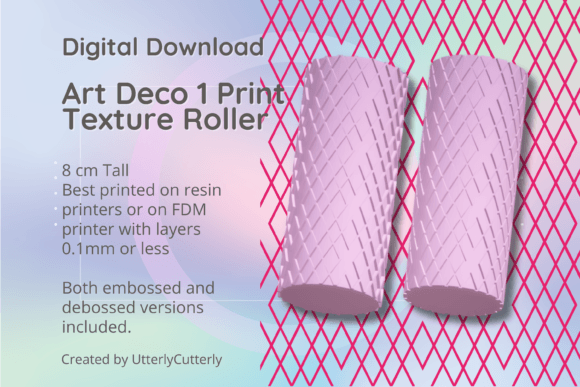
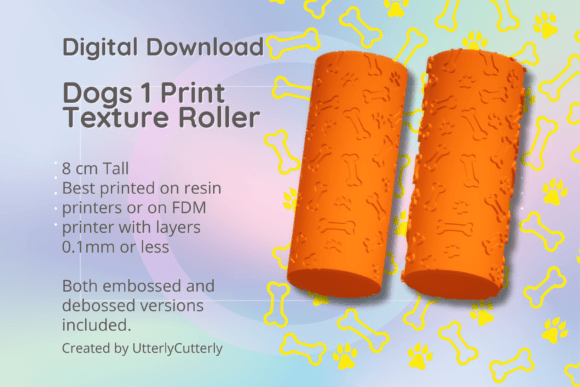
The Dog 1 Texture Roller, Animal Paw Print D is a specialized digital asset designed for makers who want to add professional-grade surface detail to their projects without the wait or expense of shipping physical tools. This specific STL file pack provides two distinct roller designs featuring embossed and debossed dog bone and paw print patterns. Because this is a digital-only product, you gain immediate access to the files after payment, allowing you to print as many rollers as you need in your own workshop. The design focuses on an 80mm tall cylinder with texture features set at a precise 1mm depth, creating crisp impressions that are deep enough to hold glazes or royal icing but shallow enough to maintain structural integrity in clay or dough.
Elevating Pet-Themed Pottery and Ceramics
For ceramicists and polymer clay artists, surface texture is often what separates a hobbyist piece from a boutique-quality product. The Dog 1 Texture Roller, Animal Paw Print D excels in this environment by offering consistent, repeatable patterning that is difficult to achieve by hand-carving. When working with leather-hard clay, the 1mm feature depth creates a shadow line that remains visible even after bisque firing and glazing. This makes it particularly useful for creating custom pet memorial tiles, personalized dog bowl rims, or decorative borders on vases intended as gifts for pet owners.
Polymer clay jewelry makers will find the dual-roller pack especially valuable for earring and pendant production. The smaller scale of jewelry requires high-definition textures that don't get lost when the clay is conditioned and rolled thin. By using the debossed version of the pattern, you can create negative space that captures metallic waxes or alcohol inks, adding contrast to lightweight statement pieces. Since the STL files are optimized for resin printing at 0.1mm layers, the resulting tool captures the fine fur details and pad textures of the paw print design, ensuring that miniature jewelry components retain visual clarity despite their small size.
Practical Applications in Custom Cookie Decorating
Bakers and cookie decorators face unique challenges when imprinting dough, primarily regarding stickiness and definition loss during baking. This texture roller addresses those issues through its specific geometry. The 1mm relief is calibrated to press into sugar cookie or gingerbread dough deeply enough to survive oven spring without cutting through the base. This makes it an essential tool for pet bakery businesses or home bakers creating "dog birthday" treats. Unlike generic rolling pins, this dedicated texture roller allows you to apply the pattern uniformly across large batches, significantly reducing decoration time compared to hand-piping individual paw prints.
Versatility extends beyond standard cookies to fondant work and gum paste modeling. Cake designers creating pet-themed celebration cakes can use the roller to texture fondant panels before draping them over cake tiers. The seamless nature of the digital file means the pattern repeats perfectly around the 80mm circumference, eliminating awkward gaps or misaligned motifs that often occur with cheaper, mass-produced plastic rollers. For royal icing transfer work, the embossed version serves as a mold; you can pipe icing directly into the recesses of the printed roller, let it set, and then peel away a perfect, textured icing appliqué to place on smooth cookies or cakes.
Optimizing Print Settings for Functional Tools
While the Dog 1 Texture Roller, Animal Paw Print D is designed to be user-friendly, the quality of your final impression depends heavily on how you manufacture the tool itself. These STL files are engineered to be printed without supports, which preserves the smoothness of the rolling surface and eliminates post-processing marks. However, material choice and layer height are critical variables. Printing in standard PLA at 0.2mm layer height is possible, but users should expect visible layer lines that may transfer onto soft clay or fondant. This finish might be acceptable for rustic pottery textures but is generally too rough for delicate jewelry or smooth cookie surfaces.
To achieve the smoothest possible texture with minimal sanding, we strongly recommend using a resin printer or setting your FDM printer to 0.1mm layer height. Resin printers, in particular, produce a glass-like surface finish that releases cleanly from sticky media like polymer clay and marzipan. If you must use FDM technology, our tested baseline settings provide a reliable starting point: a 0.4mm nozzle, 40 mm/sec print speed, and 0.1mm layer height. These parameters balance print time with surface fidelity. Always remember that every 3D printer and slicer combination behaves differently; you may need to adjust flow rates or cooling settings based on your specific hardware to prevent artifacts that could ruin the texture's usability.
Understanding Digital File Advantages and Limitations
Choosing a digital STL file over a physical tool offers distinct advantages for production workflows. Having the Dog 1 Texture Roller, Animal Paw Print D as a printable file means you can replace worn-out tools instantly, print multiple sizes by scaling the model (within reason), or experiment with different filament materials for different applications. For example, you might print one roller in food-safe PETG for baking and another in tough resin for abrasive clay work. This flexibility is impossible with fixed physical inventory. Additionally, new STL files are added to the store weekly, allowing makers to expand their texture library continuously without accumulating clutter.
However, prospective users should be aware of the responsibilities that come with digital fabrication. This is strictly a digital-only product; nothing physical will be shipped. You are responsible for validating that the printed tool meets safety standards for your intended use, especially regarding food contact. While all our rollers undergo rigorous testing as part of our standard quality checking system before being listed, your local print quality determines the final outcome. Food safety is a function of your printer’s cleanliness, filament certification, and post-processing methods, not just the digital geometry. Users intending to sell food products made with these rollers should verify compliance with local health regulations regarding 3D-printed utensils.
Creative Expansion and Design Integration
The true value of the Dog 1 Texture Roller, Animal Paw Print D lies in how it integrates with other creative assets. Because the pattern features both embossed and debossed variations, it pairs exceptionally well with complementary texture rollers or stamp sets. Makers can layer textures—for instance, rolling a background linen texture first and then applying the paw print overlay—to create complex, multi-dimensional surfaces that look handcrafted rather than manufactured. This layering technique is particularly effective in ceramic glaze trapping, where the underlying texture holds darker glazes while the raised paw prints remain glossy and light.
For entrepreneurs running Etsy shops or craft stall businesses, this digital asset reduces overhead while increasing product variety. Instead of stocking dozens of physical texture tools, you maintain a digital library and print on demand. This agility allows you to test market response to new pet-themed designs with zero financial risk. If a particular paw print style resonates with customers, you can scale production immediately. Conversely, if you need to pivot to a different aesthetic, you simply download the next week’s new STL release. The Dog 1 Texture Roller, Animal Paw Print D represents not just a single tool, but an entry point into a sustainable, scalable making ecosystem where creativity isn’t limited by supply chain logistics or storage space.