Oval Circle Polymer Clay Bead Roller STL: Precision Tools for Handmade Jewelry
Achieving uniformity in polymer clay jewelry is one of the most persistent challenges for makers. Whether you are crafting high-end earrings, bracelets, or decorative components, the difference between a professional finish and an amateur attempt often lies in consistency. The Oval Circle Polymer Clay Bead Roller STL is designed specifically to bridge this gap, offering a digital fabrication solution that transforms raw clay into perfectly shaped 8mm, 9mm, and 10mm oval beads. This digital download provides immediate access to a specialized tool that eliminates the guesswork of hand-rolling, allowing artisans to focus on design, color blending, and surface techniques rather than struggling with dimensional accuracy.
Solving the Consistency Challenge in Clay Work
For polymer clay artists, creating oval beads by hand is notoriously difficult. Unlike round beads, which can be rolled between palms or against a flat surface with relative ease, ovals require specific pressure points and rhythmic motion to maintain their elongated shape without developing flat spots or asymmetrical ends. Even experienced makers often find themselves sanding down imperfect beads or discarding misshapen pieces, leading to material waste and lost time. The primary goal when incorporating the Oval Circle Polymer Clay Bead Roller STL into your workflow is to standardize production. When selling jewelry, customers expect matching pairs of earrings and uniform strands for necklaces. This tool ensures that every bead produced meets exact specifications, significantly reducing post-production labor and increasing the perceived value of the finished product.
Optimizing Your 3D Print for Minimal Post-Processing
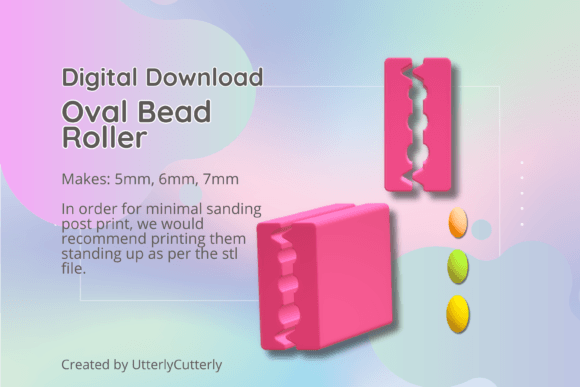
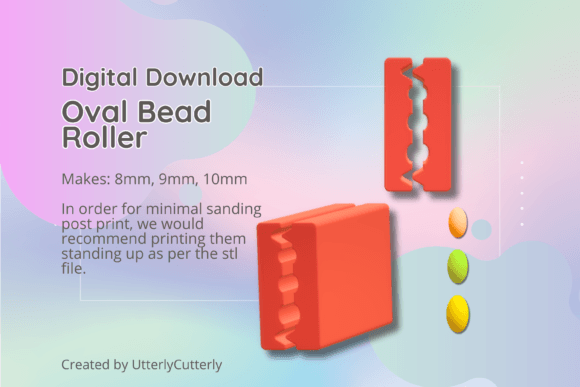
The utility of any 3D printed clay tool depends entirely on the quality of the print itself. A rough surface on a bead roller will transfer texture marks directly into your soft clay, defeating the purpose of using a precision tool. To address this, the Oval Circle Polymer Clay Bead Roller STL has been engineered to be printed in a vertical orientation. Printing the roller standing up, as specified in the file design, aligns the layer lines vertically along the length of the roller rather than horizontally across the working surface. This strategic orientation drastically reduces the need for sanding after printing. While some light finishing may still be beneficial depending on your printer’s calibration, following this recommendation ensures the smoothest possible contact surface right off the build plate.
When preparing your slicer software, specific settings are recommended to maximize the tool's performance. Using a 0.4mm nozzle at a print speed of 40 mm/sec strikes an ideal balance between structural integrity and surface finish. Slower speeds allow for better cooling and layer adhesion, which is crucial for a tool that will endure repetitive pressure. However, every 3D printer behaves differently. Makers should treat these recommendations as a baseline and perform test prints to fine-tune flow rates and retraction settings for their specific machine. A well-calibrated print not only produces better beads but also extends the lifespan of the tool itself.
Practical Applications and Creative Outcomes
The versatility of having three distinct sizes—8mm, 9mm, and 10mm—in a single digital file opens up numerous creative possibilities. Smaller 8mm ovals are excellent for delicate stud earrings, charm bracelets, or intricate mosaic work where space is limited. The 9mm size serves as a versatile middle ground, perfect for standard drop earrings and lightweight pendants. The 10mm option creates bold statement pieces, spacer beads for complex strand designs, or focal elements in mixed-media jewelry. By utilizing the Oval Circle Polymer Clay Bead Roller STL, makers can easily scale their designs up or down without needing to source new tools or recalibrate their hand-rolling technique.
Beyond simple shaping, this tool facilitates advanced surface techniques. Because the roller produces a consistent base shape, artists can confidently apply veneers, mica shifts, or silk screen patterns knowing that the underlying form will remain stable. The uniform curvature ensures that patterned sheets wrap evenly without distortion, a common issue when applying veneers to hand-formed ovals. Additionally, the predictable sizing simplifies drilling and assembly. When beads are identical in dimension, stringing them onto wire or cord becomes faster, and hardware selection becomes more straightforward since findings can be standardized across multiple projects.
Commercial Use and Business Scalability
For makers operating a jewelry business, efficiency directly correlates to profitability. This digital product includes a commercial license for physical products created using the tool, such as earrings, necklaces, and other wearable art. This permission allows entrepreneurs to integrate the Oval Circle Polymer Clay Bead Roller STL into their production line without legal concern. The ability to rapidly produce uniform components means less time spent on quality control and more time dedicated to marketing, photography, and customer engagement. Furthermore, because this is a digital download, there is no shipping wait time. Production capacity can be expanded instantly; if a roller wears out or breaks, a replacement can be printed within hours rather than days.
Different users will approach this resource based on their current infrastructure and skill level. Beginners may use the roller primarily as a learning aid to understand proper clay conditioning and pressure application, using the tool to train their hands before attempting freehand shaping. Intermediate makers often utilize it to fill gaps in their inventory, producing specific sizes needed to complete collections. Professional studios may print multiple rollers to create dedicated stations for different colors or clay types, preventing cross-contamination and streamlining batch production. Regardless of experience level, the digital nature of the file allows for customization; advanced users with CAD skills can even modify the STL to adjust dimensions or add ergonomic handles to suit their personal preferences.
Important Considerations for Digital Tool Acquisition
Purchasing a digital fabrication file differs significantly from buying a physical tool. It is vital to understand that this is a digital-only product; no physical item will be shipped. Access to the files is granted immediately upon payment, enabling instant project commencement. Due to the nature of digital goods, returns, exchanges, or cancellations cannot be accepted once the file has been downloaded. This policy protects intellectual property while placing the responsibility of successful implementation on the user’s equipment and settings. However, support remains available for technical issues related to the file itself. All cutters and rollers undergo rigorous testing as part of a standard quality checking system before being listed, ensuring that the geometry is sound and functional.
Makers should also consider expanding their toolkit ecosystem. While the Oval Circle Polymer Clay Bead Roller STL addresses specific oval requirements, complementary tools for rounds, tubes, and specialty shapes are often available in bundles. Investing in comprehensive sets can provide greater long-term value and ensure stylistic cohesion across diverse product lines. Ultimately, this digital resource represents more than just a 3D model; it is a productivity multiplier that empowers polymer clay artists to achieve professional consistency, reduce waste, and scale their creative businesses with confidence. By leveraging precise digital fabrication, makers can elevate their craft from hobbyist experimentation to reliable, high-quality manufacturing.