Leaf 1 Clay Cutter - Autumn Fall STL Digital File Evaluation
The Leaf 1 Clay Cutter - Autumn Fall STL Dig is a digital fabrication asset designed for creators who utilize 3D printing technology to produce custom tools. This product is not a physical object but rather a collection of stereolithography (STL) files intended for immediate download and local manufacturing. The bundle focuses specifically on autumnal leaf motifs, providing a versatile set of shapes suitable for polymer clay jewelry, ceramic detailing, or cookie decoration. For makers evaluating their tooling options, understanding the technical specifications and practical applications of this digital pack is essential for determining if it aligns with current production capabilities and artistic goals.
Technical Specifications and Print Variants
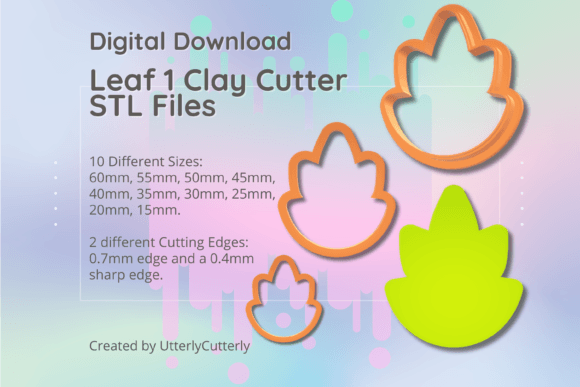
A primary consideration when selecting digital cutter files is the engineering behind the cutting edge and structural integrity. The Leaf 1 Clay Cutter - Autumn Fall STL Dig addresses varied user preferences by including two distinct cutter types within the same package. This duality allows users to select the geometry that best suits their specific material and printer calibration.
- Standard Wall Variant: This design features a 0.7mm wall thickness with a cutting edge that matches the wall width. It includes a 3mm thick base and stands 12mm tall. This version is generally more forgiving during the printing process and offers increased durability for stiffer clay bodies.
- Sharp Edge (SE) Variant: Abbreviated as SE in the file names, this version utilizes a 1mm support wall that tapers to a precise 0.4mm cutting edge. Like the standard variant, it has a 3mm base and 12mm height. This geometry is engineered for cleaner cuts in softer materials but requires precise bed leveling and flow rate calibration to print successfully without fragility issues.
Both variants share consistent dimensional standards. If embossing lines are present in the design, they are set at 10.5mm tall. This specification indicates that the cutters are optimized for clay sheets thicker than 1.5mm to ensure the embossed detail registers clearly without bottoming out. Users working exclusively with very thin veneers should account for this depth requirement during their planning phase.
Size Versatility and Scaling Considerations
The utility of a digital cutter bundle often hinges on the range of available sizes. This pack provides ten discrete size increments, measured from the longest ends of the leaf shape. The included sizes are 60mm, 55mm, 50mm, 45mm, 40mm, 35mm, 30mm, 25mm, 20mm, and 15mm. This graduated scaling supports hierarchical design work, such as creating earring sets where the stud and dangle components share a motif but differ in scale.
Because these are vector-based 3D models, users retain the flexibility to scale files beyond the provided dimensions within their slicer software. However, the pre-set sizes offer a tested baseline for structural stability. When evaluating this pack against single-size alternatives, the value proposition lies in this curated range, which eliminates the need to manually resize and test-print individual files to find functional proportions.
Practical Applications and Material Compatibility
The Leaf 1 Clay Cutter - Autumn Fall STL Dig serves multiple creative disciplines, though performance varies by medium. For polymer clay artists, the 12mm height provides ample clearance for handling and prevents fingers from pressing into the clay surface during extraction. The sharp edge variant is particularly effective for raw polymer clay, reducing drag and deformation. For ceramicists using soft slabs, the standard 0.7mm wall may provide necessary rigidity to prevent the cutter from warping under pressure.
In culinary applications, such as cookie cutting, food safety becomes the primary evaluation metric. While the STL files can be printed in food-safe filaments like PLA, the layer lines inherent in FDM printing can harbor bacteria. Users intending to use these cutters for food must apply appropriate post-processing, such as food-grade epoxy coating, or reserve them strictly for non-edible crafts. The digital nature of the product means safety compliance is entirely the responsibility of the end-user's manufacturing and finishing process.
Evaluating Fit: When to Choose Digital Over Physical
Selecting a digital STL file over a pre-manufactured physical cutter involves specific tradeoffs. This product is a strong fit for individuals who already own a reliable 3D printer and possess intermediate slicing knowledge. The ability to generate replacements instantly, modify sizes, or mix and match with other weekly releases from the store offers long-term sustainability that physical inventory cannot match. It is also ideal for creators who require specific seasonal aesthetics immediately, bypassing shipping delays associated with physical goods.
Conversely, alternatives may be worth considering for those without access to 3D printing hardware or those unwilling to manage printer maintenance. If a maker requires guaranteed dimensional accuracy without personal calibration, or if they lack the time to troubleshoot print failures, purchasing physical metal or plastic cutters remains the more efficient path. Additionally, makers who do not work with materials requiring frequent tool replacement may find the upfront cost of physical tools more economical than maintaining filament stocks and printer wear for occasional digital fabrication.
Decision-Making Insights for Makers
When integrating the Leaf 1 Clay Cutter - Autumn Fall STL Dig into a workflow, prospective users should assess their current library of assets. The design philosophy encourages curation; these files are intended to complement other STL packs through consistent sizing and aesthetic coherence. Evaluating whether this autumn leaf motif fills a gap in an existing collection or duplicates current assets helps determine immediate ROI.
Furthermore, users should verify their printer’s capability to handle the 0.4mm Sharp Edge variant before committing to large-scale production. Printing a single test cutter in the SE style is a recommended validation step. If the test print fails due to nozzle diameter limitations or cooling inefficiencies, the standard 0.7mm variant serves as a robust fallback. Understanding these technical boundaries ensures that the digital acquisition translates effectively into tangible creative output.
Ultimately, this digital bundle represents a shift toward decentralized manufacturing for craft tools. It offers autonomy and customization for the equipped maker while demanding technical proficiency. By weighing the benefits of instant access and size variety against the requirements of self-production, creators can make an informed decision that supports both their artistic vision and operational efficiency.