Fried Egg 1 Clay Cutter - Breakfast Food: Digital STL Files for Polymer Clay and Baking
There is something universally charming about the humble fried egg that transcends actual breakfast food. In the world of miniature crafting, polymer clay jewelry, and kawaii aesthetics, the Fried Egg 1 Clay Cutter - Breakfast Food digital bundle serves as a foundational tool for creators who want to capture that playful, nostalgic vibe without the hassle of hand-cutting inconsistent shapes. This isn't just a cookie cutter; it is a precision-engineered digital asset designed specifically for the unique demands of soft clay work and detailed baking. By offering an instant STL download, this pack eliminates shipping wait times and allows makers to iterate on their designs immediately, whether they are prototyping a new earring line at midnight or prepping for a weekend craft market.
Versatility Across Creative Disciplines
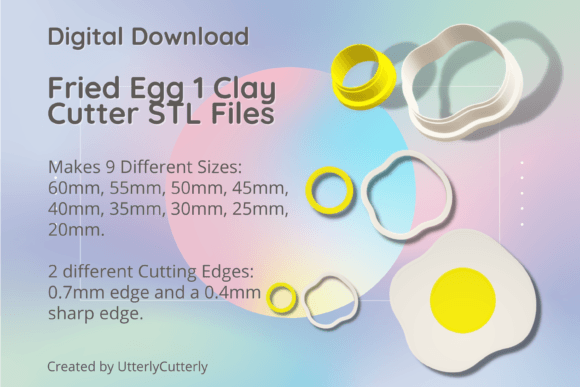
The true value of this fried egg cutter set lies in its adaptability across different mediums. While marketed toward clay artists, the utility extends far beyond polymer creations. For jewelry makers, the organic, slightly irregular shape of a fried egg provides a perfect canvas for resin inlays, mica powder shifts, and translucent clay techniques. The yolk area acts as a natural focal point, allowing artisans to create depth by layering colors or embedding tiny charms. Because the files come in nine distinct sizes, you aren't locked into a single scale. A maker can produce a statement necklace pendant using the 60mm cutter and matching stud earrings with the 20mm version, ensuring visual cohesion across a collection.
Bakers and cake decorators also find immense practical use in these STL files. Unlike standard metal cutters that often have dull edges unsuitable for fondant or gum paste, these 3D-printed tools offer specific edge profiles. The sharp edge variant allows for clean cuts through rolled icing without dragging or tearing, which is essential when creating realistic breakfast-themed cake toppers or macaron decorations. The ability to print your own tools means you can replace a worn cutter instantly or adjust the design file if you need a slightly deeper rim for thicker doughs, giving culinary artists a level of customization that commercial kitchen supplies simply cannot match.
Understanding Edge Profiles for Specific Materials
One of the most critical considerations before printing and using these files is selecting the correct edge type for your specific material. The bundle includes two distinct cutting edge designs, and understanding the difference prevents wasted filament and ruined projects.
- Standard 0.7mm Wall: This cutter features a 0.7mm wall thickness with a 3mm thick base and 12mm height. It is the workhorse option, ideal for softer polymer clays like Sculpey III or Fimo Soft. The slightly wider blade compresses the clay rather than slicing it cleanly, which helps prevent the delicate egg shape from distorting during the lifting process. This edge is also safer for younger crafters or those working with children, as it lacks a razor-sharp profile.
- Sharp Edge (SE): Abbreviated as SE in the file names, this variant boasts a 1mm support wall tapering to a precise 0.4mm cutting edge. This is indispensable for firm clays like Kato Polyclay or Cernit, as well as for baking applications. The sharper profile reduces drag significantly, resulting in crisp, professional edges that require minimal post-processing sanding. However, users should exercise caution during handling and storage, as the thin edge can be fragile if dropped or used on overly stiff materials.
Sizing Strategy for Curated Collections
Having access to sizes ranging from 20mm to 60mm in 5mm increments solves one of the most common frustrations in clay art: proportion. When designing a "breakfast plate" scene, a 60mm egg next to a 55mm toast looks unbalanced. With this graduated sizing system, creators can curate custom combos that mimic real-world perspective. The 30mm and 35mm sizes are particularly popular for charm bracelets and phone case embellishments, where space is limited but detail is paramount. Conversely, the larger 50mm to 60mm range caters to the growing trend of oversized clay jewelry and home decor items like fridge magnets or trinket dishes.
This sizing flexibility also benefits sellers on platforms like Etsy or Shopify. Instead of listing a single product, makers can offer tiered pricing based on size or create bundle listings that showcase the entire range. Since the cutter size is measured from the longest ends, users should always test print a single size first to verify dimensions against their specific printer’s tolerance settings, as slight shrinkage can occur depending on the filament brand and cooling configuration.
Technical Considerations for Embossing and Depth
For artists looking to add texture or dimension to their fried eggs, the embossing specifications are vital. Any embossing lines included in the design stand 10.5mm tall. This measurement dictates your material preparation; to achieve a clear impression without breaking through the back of the piece, your clay must be conditioned to a thickness greater than 1.5mm. Working with clay thinner than this threshold risks structural failure or visible reverse impressions.
This height specification also influences how you condition and roll your clay. Using consistent spacer rings or an adjustable pasta machine setting ensures that every egg cut has uniform depth, which is crucial for batch production. If you plan to use the embossed version for baking, ensure your dough has enough elasticity to hold the impression during the rising or baking process. Stiffer cookie doughs generally retain embossed details better than high-fat shortbreads, which may spread and obscure the finer lines.
Optimizing Your 3D Printing Workflow
Since this is a digital download and not a physical item, the quality of your final tool depends entirely on your print settings. These STL files are optimized for easy printing, but best practices still apply. Printing with a 0.4mm nozzle at 100% infill for the first few layers creates a solid base that resists warping. For the cutting walls, reducing infill to 20-30% is usually sufficient, provided the outer walls are set to at least three perimeters. This maintains rigidity while saving time and material.
Material choice matters as much as geometry. PLA is the standard for clay cutters due to its stiffness and ease of printing, but it can become brittle over time. PETG offers a better balance of durability and flexibility, making it superior for the Sharp Edge variants that might encounter resistance in firm clay. Regardless of material, always inspect the printed cutter for layer adhesion issues before use; a delaminated edge can tear clay or leave unwanted ridges. Post-processing with fine-grit sandpaper or a needle file can smooth out any Z-seam artifacts, ensuring the finished clay piece releases cleanly.
Expanding Your Creative Toolkit
The Fried Egg 1 Clay Cutter - Breakfast Food pack is designed to integrate seamlessly with other digital assets. Because new STL files are added to the store weekly, creators can build a comprehensive library of complementary shapes—think bacon strips, toast slices, or coffee mugs—that share the same technical specifications and aesthetic language. This consistency reduces the learning curve when trying new designs and ensures that all elements in a mixed-media project feel cohesive.
Ultimately, this digital bundle represents a shift toward sustainable, on-demand manufacturing for individual artists. Rather than accumulating plastic tools that may only be used once, you download exactly what you need, print it locally, and recycle failed prints or worn-out cutters responsibly. Whether you are a professional jeweler refining a signature style or a hobbyist exploring the tactile joy of polymer clay, having immediate access to tested, versatile cutter files removes technical barriers and keeps the focus where it belongs: on the creative process itself.