Clay Cutter STL File: Soccer Football Ball Bundle
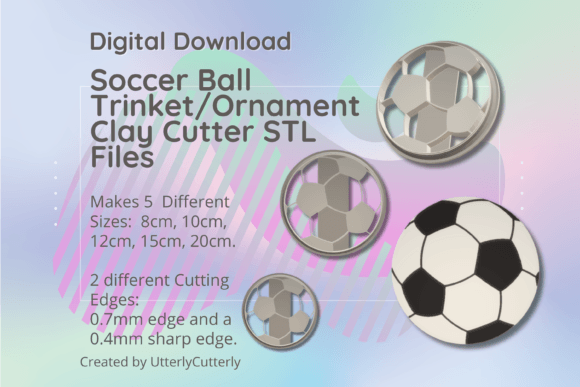
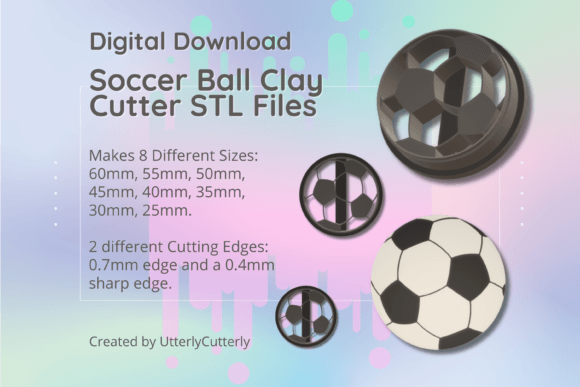
Creating themed accessories and edible decorations requires precision tools that balance detail with functionality. The Clay Cutter STL File Soccer Football Bal bundle provides a comprehensive digital solution for makers who own 3D printers and want to produce professional-grade results at home or in a small studio. Rather than purchasing single-use plastic cutters that may not fit specific project dimensions, this digital download allows you to manufacture exactly what you need on demand. This approach supports sustainable crafting practices by reducing waste and eliminating shipping times, giving you immediate access to eight distinct sizes and two specialized cutting edge profiles.
For entrepreneurs selling sports-themed jewelry or parents creating personalized party favors, having control over cutter size is essential. A 60mm cutter serves a completely different purpose than a 25mm one, yet both are necessary for a cohesive product line. By utilizing these STL files, you can curate custom combinations that match your specific clay thickness, cookie dough consistency, or fondant requirements without compromising on structural integrity or aesthetic appeal.
Selecting the Right Edge Profile for Your Medium
Not all crafting materials behave identically under pressure, which is why this bundle includes two distinct cutter types. Understanding the technical differences between the standard wall and the Sharp Edge (SE) variant ensures you select the appropriate tool for your current project, preventing material distortion and reducing post-processing time.
Standard 0.7mm Wall Cutters
The standard cutter features a 0.7mm wall thickness with a 3mm thick base and a total height of 12mm. This profile offers increased rigidity, making it ideal for denser materials like polymer clay or stiff cookie dough. The thicker wall provides better grip and reduces the likelihood of the cutter bending during use. This durability is particularly valuable when working with children or when cutting large batches where repetitive force is applied. The 3mm base also offers a comfortable surface area for your thumb, improving control and safety during extended crafting sessions.
Sharp Edge (SE) Variants
Files abbreviated as SE in the download package feature a 1mm support wall tapering to a precise 0.4mm cutting edge. While the base remains 3mm thick and 12mm tall for ergonomic consistency, the thinner blade slices through delicate materials with minimal resistance. This design is superior for soft fondant, gum paste, or thin ceramic sheets where dragging or tearing is a concern. The sharper edge produces cleaner lines that require less smoothing after demolding, saving significant finishing time for detailed jewelry components like pendants and earrings.
Size Versatility Across Eight Dimensions
Consistency in scaling is difficult to achieve when mixing cutters from different manufacturers. This bundle solves that problem by providing a graduated set measured from the longest ends: 60mm, 55mm, 50mm, 45mm, 40mm, 35mm, 30mm, and 25mm. This systematic progression allows for intentional design hierarchy in your work.
- Jewelry Applications: The 25mm and 30mm sizes are optimal for stud earrings and charm bracelets, where lightweight comfort is paramount. The 35mm and 40mm options work well for statement pendants and hair barrettes.
- Culinary Uses: For cookies and biscuits, the 50mm to 60mm range provides substantial surface area for icing details. Smaller sizes serve as accents on cupcakes or cake borders.
- Seasonal Decorations: Christmas ornaments and gift tags benefit from the mid-range sizes (40mm–50mm), offering enough space for personalization while remaining lightweight enough to hang securely.
Having the full spectrum available digitally means you can test print multiple sizes to determine the perfect scale for a new product line before committing to mass production. This flexibility eliminates the guesswork often associated with ordering physical tools online based solely on thumbnail images.
Embossing Line Considerations
If your selected design includes embossing lines, note that they are engineered to be 10.5mm tall. To achieve a clear impression without breaking through the material, you must work with clay or dough thicker than 1.5mm. Using material thinner than this threshold will result in incomplete impressions or structural failure. Always measure your rolled material with calipers or thickness guides before cutting to ensure compatibility with the embossing depth.
Optimizing Print Settings for Functional Tools
Because these are digital files rather than finished products, the quality of your final cutter depends heavily on your printer settings. These STL files are designed to be easily printed, but achieving food-safe and durable results requires attention to slicer parameters.
For food-related applications such as cookies and fondant, print orientation matters significantly. Printing cutters vertically with the cutting edge facing up minimizes layer lines on the contact surface, resulting in smoother cuts and easier cleaning. Use 100% infill to prevent bacterial growth in internal voids and increase overall strength. A nozzle temperature appropriate for your filament type is essential; PLA is common for its ease of printing, but PETG offers higher heat resistance if you plan to wash cutters in warm water.
When printing the Sharp Edge variants, ensure your cooling fan is optimized to prevent the thin 0.4mm tip from warping. A brim may be necessary for the larger 60mm cutters to maintain bed adhesion, though the 3mm base generally provides sufficient footprint for reliable first-layer success. Post-print inspection should always include checking for layer separation or stringing that could affect hygiene or cut quality.
Integrating Digital Assets Into Creative Workflows
The primary advantage of choosing a Clay Cutter STL File Soccer Football Bal bundle over physical inventory is workflow integration. Small business owners and freelancers can respond to trends instantly. If a local soccer team advances to championships, you can print additional cutters within hours rather than waiting days for shipping. This agility transforms how creators manage seasonal demand and custom orders.
Educators and workshop leaders also benefit from this format. Instead of purchasing expensive sets that may break or go missing, you can print replacement cutters as needed or adjust sizes to suit different age groups. Younger participants may handle the larger, sturdier standard cutters more easily, while advanced students can explore fine detail work with the SE variants and smaller dimensions.
Furthermore, owning the digital asset encourages experimentation. You can modify print settings to create flexible TPU cutters for curved surfaces or rigid PLA versions for flat work. This level of customization is impossible with commercially manufactured tools and opens new creative possibilities for mixed-media artists exploring texture and form.
Practical Limitations and Safety Guidelines
While 3D printed cutters offer remarkable versatility, users should understand their limitations compared to injection-molded alternatives. Layer lines are inherent to FDM printing and may transfer subtle textures to soft materials. For mirror-finish jewelry, additional sanding or coating of the cutter edge may be necessary. Food safety remains a user responsibility; always verify filament certification and consider using dedicated printers for culinary tools to avoid cross-contamination from previous non-food prints.
Additionally, remember that this is strictly a digital download. No physical item will be shipped. Ensure you have access to a functioning 3D printer and basic slicing software before purchasing. New STL files are added to the store weekly, allowing you to expand your collection gradually as your skills and equipment capabilities evolve. By treating these files as foundational tools rather than disposable novelties, you build a sustainable, scalable resource library that grows alongside your creative practice.